As Amazon Associates, we earn from qualifying purchases. This means we may receive a small commission at no extra cost to you if you click through and make a purchase.

- Brand
- Xbox
- Buyer rating
- 4.0 out of 5
- Mostly positive, average of Amazon buyer ratings
When examining the official xbox s series wireless controller specs, hardware enthusiasts and competitive players look beyond aesthetic choices to evaluate protocol switching speed, bus latency, and ergonomic durability. The Xbox Wireless Controller serves as Microsoft’s unified input device across modern home consoles and external computing ecosystems. Designed to interface natively with the compact Xbox Series S as well as the flagship Series X, legacy hardware, and personal computers, this gamepad standardizes wireless polling and peripheral connectivity across multiple platforms. Evaluating this peripheral requires a detailed look at its physical architecture, input matrix, and interface flexibility to ensure it matches the technical demands of your gaming environment.
Whether you are outfitting a secondary desktop station or expanding a multi-user console setup, verifying hardware standards prevents interface bottlenecks and signal dropouts. This analysis provides an exhaustive breakdown of the controller’s internal connection protocols, dimensional envelope, tactile switch architecture, and swappable power implementation. The following sections investigate the complete mechanical loadout, firmware remapping utility, cross-generational backward compatibility, and direct performance characteristics so you can determine if this hardware revision fulfills your specific input requirements.
What You Get With the Xbox Wireless Controller
The retail package delivers the dedicated gamepad assembly engineered for immediate deployment across supported consoles, computers, and mobile devices:
- One Xbox Wireless Controller in the Mineral Camo Special Edition finish
- Integrated hybrid D-pad engineered for multidirectional tactile feedback
- Molded textured grip surfaces across the triggers, bumpers, and rear chassis
- Dedicated hardware Share button designed for rapid media capture and content broadcast
- Modular rear battery enclosure supporting standard AA cell configurations
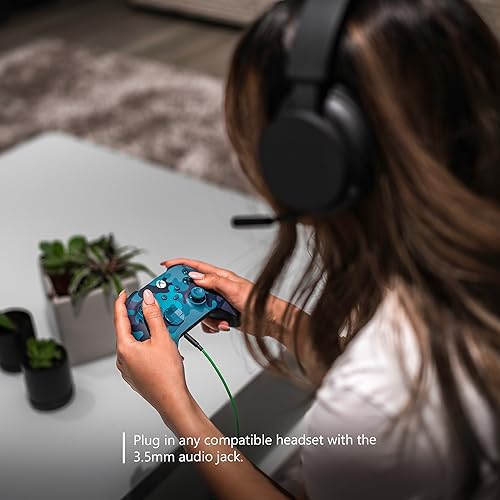
- Universal 3.5mm stereo headset audio jack for direct analog sound passthrough
- Standard USB-C interface port for wired gameplay and direct bus power
Key Specifications
| Hardware Attribute | Technical Specification |
|---|---|
| Manufacturer & Brand | Microsoft Xbox |
| Model Designation & Number | Mineral Camo Special Edition (Model QAU-00073) |
| Global Identifiers | UPC: 889842823950 / GTIN: 00889842823950 |
| Physical Dimensions | 2.83 x 7.01 x 6.97 inches |
| Input Switch Quantity | 16 physical control buttons |
| Wireless Protocols | Xbox Wireless proprietary RF and Bluetooth |
| Wired Connectivity | USB-C interface port |
| Audio Passthrough | Integrated 3.5mm audio headset jack |
| Power Source & Battery Life | Dual AA batteries with up to 40 hours runtime |
| Hardware Regulatory Certification | ANATEL: 08294-20-01569 |

Cross-Platform Connectivity and Protocol Switching
The device leverages dual-mode wireless capabilities, integrating Microsoft’s proprietary Xbox Wireless protocol alongside standard Bluetooth connectivity. When paired with an Xbox Series S, Xbox Series X, or Xbox One console, the controller operates over a direct radio frequency link optimized for rapid input delivery and integrated stereo audio streaming through the 3.5mm jack. For external hardware such as Windows PCs, Android smartphones, and iOS handhelds, the onboard Bluetooth radio enables universal driverless syncing. Switching between these systems is accomplished via the hardware pairing sequence, allowing a user to alternate between a living room console and a mobile device without repetitive resynchronization steps.
Evaluating the xbox series s controller for pc gaming reveals significant advantages in desktop workflows, particularly for users managing diverse input peripherals alongside custom desktop hardware like the keychron q5 max mechanical keyboard. On Windows environments, connecting via Bluetooth provides broad compatibility with modern games and emulation suites, while plugging directly via a USB-C cable switches the device to direct bus transmission, eliminating wireless interference entirely. While the listing does not specify exact millisecond input delay metrics, the xbox wireless controller latency specs generally depend on the active transmission path, with wired USB-C and native Xbox Wireless protocols providing tighter signal loops than standard consumer Bluetooth connections.
A major consideration for multi-device owners is how the peripheral manages network overhead and pairing handshakes across diverse operating systems. The controller maintains connection profiles for quick transitions between desktop PCs, mobile operating systems, and home consoles. Verifying xbox series s controller bluetooth compatibility across mobile platforms confirms support for Android and iOS systems, granting mobile gamers access to full analog thumbstick sweeps and digital bumper triggers without third-party mapping wrappers. For desktop users requiring low-latency audio transmission directly through the 3.5mm headset jack, connecting via USB-C or an official wireless adapter remains necessary, as basic Bluetooth bandwidth constraints typically restrict high-fidelity voice and sound channels simultaneously.

Interface Mechanics and Tactile Control Surfaces
Physical manipulation on the controller is driven by a 16-button input matrix paired with dual asymmetric analog thumbsticks. Central to this updated hardware generation is the xbox wireless controller hybrid d-pad, which merges the discrete cardinal directions of a traditional cross layout with the angled facets of an octagonal dish. This geometry supports precise four-way inputs for menu navigation and inventory selection, while providing tactile diagonal transitions essential for fighting games and complex movement mechanics. The faceted dish yields a clicky tactile return on actuation, ensuring players receive immediate mechanical confirmation during intense directional sequences.
Surface texture plays a fundamental role in sustained operational control during marathon gaming sessions. Microsoft implemented engineered tactile dot patterns across the primary trigger surfaces, shoulder bumpers, and the outer contours of the rear chassis. This micro-textured treatment increases grip stability against skin moisture without requiring rubberized coatings that can wear or peel over extended operational lifespans. The triggers also house internal rumble motors that work alongside the primary chassis vibration modules, conveying localized haptic feedback such as vehicle acceleration, surface traction changes, and weapon recoil directly to the user’s fingertips.
Positioned directly between the primary View and Menu buttons is the dedicated hardware Share button. This centralized toggle interfaces natively with the operating system on Xbox Series S, Series X, and Windows environments, allowing players to initiate single-frame screen captures with a short press or capture rolling gameplay video buffers with an extended hold. By offloading media capture shortcuts to a dedicated microswitch, the layout prevents accidental inputs during core gameplay while eliminating the need to pull up software overlays or complex multi-button key combinations.

Modular Power Engineering and Runtime Performance
Power delivery represents one of the most distinct architectural choices in the controller’s design. Rather than sealing a non-removable lithium-ion pouch inside the casing, Microsoft retained a modular rear battery bay engineered to accept standard AA dry cells or rechargeable nickel-metal hydride batteries. According to manufacturer specifications, the xbox series s controller battery life aa reaches up to 40 hours of continuous runtime depending on usage conditions, rumble activation intensity, and whether a wired headset is drawing power directly from the 3.5mm port. This modular design prevents the entire controller from becoming obsolete when an internal battery inevitably degrades over hundreds of charge cycles.
For continuous stationary use, the xbox series s controller usb-c connectivity provides direct tethered operation without requiring any batteries inside the compartment. Connecting a standard USB-C cable to the top-mounted port converts the gamepad into a bus-powered input peripheral, drawing current directly from the host console or PC USB port. This flexibility is particularly useful in tournament environments, crowded wireless setups, or home offices where peripheral charging cables are already integrated alongside printing and computing stations like the brother work smart 1360 wireless color inkjet all-in-one printer. When operating over USB-C, the controller bypasses RF transmission entirely, sending data packets straight across the wired bus.
The trade-off of this power setup centers on recurring battery maintenance for wireless users who do not purchase auxiliary charging accessories. While third-party rechargeable packs and official play-and-charge kits can be dropped directly into the rear cavity, the base retail packaging includes no charging cable or internal rechargeable pack, relying instead on standard disposable cells. Users must balance the long-term sustainability and immediate zero-downtime swapping of AA batteries against the minor convenience of embedded lithium gamepads that charge on standard phone stands.
Firmware Customization and Mineral Camo Structural Design
The mechanical shell of this unit showcases the xbox mineral camo special edition specs, featuring an overlapping camouflage palette of mineral blue, bright purple, aqua, and dark purple accents. With external physical dimensions measuring 2.83 inches deep, 7.01 inches wide, and 6.97 inches high, the chassis features refined sculpted contours engineered to fit a broader variety of hand spans comfortably. The internal structural rigidity prevents body flex under heavy torsional stress, while the matte finish across the faceplate resists superficial fingerprint smudges during intense gaming sessions in media entertainment spaces or beside themed gear like an xbox series x mini fridge.
Software control is managed through the official Xbox Accessories application, available across Xbox consoles and Windows operating systems. Using this interface, owners can configure xbox series s controller button mapping to suit physical accessibility needs or game-specific tactical preferences. The software suite permits swapping digital inputs across the 16 available buttons, inverting analog thumbstick axes, adjusting trigger actuation thresholds, and saving individual profile presets mapped to specific software titles. Firmware updates delivered over the air or via USB-C ensure persistent protocol stability and patch compatibility with upcoming operating system builds.
A key technical detail confirming Microsoft’s manufacturing standards is the hardware regulatory compliance marked by ANATEL certification code 08294-20-01569 and model identifier QAU-00073. These verifiable identifiers guarantee that the unit adheres to strict electromagnetic shielding, transmission frequency limitations, and internal build tolerances. Every button switch in the 16-input layout is calibrated for repeatable actuation force, ensuring that inputs register reliably without phantom triggers or mechanical stick drift during regular operating parameters.
Xbox Wireless Controller Pros and Cons
Pros
- Up to 40 hours battery life with AA cells
- Dual Xbox Wireless and Bluetooth protocol switching
- Tactile hybrid D-pad engineered for precise inputs
- Integrated 3.5mm audio headset jack and USB-C port
- Textured grip on triggers, bumpers, and back-case
Cons
- Requires external AA batteries without optional rechargeable kit
- Audio passthrough restricted over standard Bluetooth connections
- USB-C cable not included in standard package
Is the Xbox Wireless Controller Worth It
Deciding if the official pad fits your current setup depends heavily on your hardware priorities and ecosystem requirements. When assessing whether is xbox series s controller worth it for console owners, the answer is an unqualified yes: native integration with the Xbox Series S and Series X guarantees zero setup hurdles, instant wake-on-press power cycling, and flawless multi-channel audio delivery through the 3.5mm headset jack. For console players who prioritize immediate peripheral responsiveness, native system menu navigation, and official hardware reliability, this gamepad stands as the definitive baseline standard.
For PC and mobile gaming enthusiasts, the value proposition remains exceptionally strong due to native Windows XInput driver support and dual-mode Bluetooth connectivity. Unlike competing controllers that require third-party mapping software, virtual controller emulators, or custom driver overrides on Windows, Microsoft’s controller operates seamlessly right out of the box with virtually every modern PC title. Furthermore, the inclusion of a swappable AA battery system gives it an operational lifespan far exceeding controllers with non-replaceable lithium batteries that lose capacity after two to three years of daily cycles.
However, users who demand integrated back paddles, trigger-stop hair locks, or bundled lithium battery packs out of the box may find the standard specification limiting. The controller is engineered as an industry-standard workhorse rather than an esports-customized modular platform. If your priority is a rock-solid, ergonomically proven gamepad with outstanding cross-platform protocol switching, tactile hybrid D-pad inputs, and long-term chassis durability, this Mineral Camo edition represents an exceptional hardware investment.
FAQ
Can the Xbox Wireless Controller be used on a PC without batteries?
Yes. When connected directly to a Windows PC using a standard USB-C cable, the controller functions as a bus-powered wired gamepad. It draws operating power straight through the USB interface, allowing full control functionality without any AA batteries installed in the rear compartment.
Does the controller support custom button remapping on mobile devices?
Button remapping and custom profile configuration are handled through the official Xbox Accessories application, which is natively available on Xbox consoles and Windows PCs. While the listing confirms Bluetooth compatibility with Android and iOS devices, full system-level button remapping profiles must typically be configured within compatible host apps or on a Windows/Xbox system first.
What is the battery life of the controller when using standard AA cells?
The manufacturer specifications state that the controller delivers up to 40 hours of continuous operational battery life when powered by standard AA batteries. Actual battery longevity varies based on rumble motor activity, connection protocol, and whether a wired headset is drawing power from the 3.5mm audio jack.
Does the 3.5mm audio headset jack work over Bluetooth?
Audio passthrough through the integrated 3.5mm jack is fully supported when connected via the proprietary Xbox Wireless protocol on Xbox Series S, Xbox Series X, Xbox One, or via direct USB-C connection. Standard Bluetooth protocol limitations generally prevent high-bandwidth audio passthrough when paired wirelessly with standard Bluetooth hosts.
What does the hybrid D-pad offer compared to traditional directional pads?
The hybrid D-pad combines the distinct four-way cardinal cross with a faceted circular dish. This hybrid mechanical shape gives players tactile click feedback for precise cardinal directions while facilitating smooth, rapid diagonal sweeps essential for fighting games and complex movement controls.
See the current listing on Amazon
Specifications on this page are read from the product listing. Ratings are the average left by Amazon buyers.