As Amazon Associates, we earn from qualifying purchases. This means we may receive a small commission at no extra cost to you if you click through and make a purchase.

- Brand
- HOVER Air
- Buyer rating
- 4.3 out of 5
- Mostly positive, average of Amazon buyer ratings
The HOVERAir X1 represents a dedicated shift in personal videography, focusing entirely on autonomous self-flying capture rather than long-distance manual piloting. For content creators, cyclists, and outdoor athletes evaluating whether this camera fits their kit, the decisive factor lies in its execution as a hands-free personal cameraman. Unlike conventional camera drones that require dedicated multi-stick radio controllers and constant pilot input, this system uses visual tracking algorithms and pre-programmed flight trajectories to capture dynamic solo angles directly from palm takeoff.
In this technical evaluation, we analyze the core capabilities and practical boundaries of the HOVERAir X1 hardware and software ecosystem. Our breakdown covers the performance thresholds of the automated tracking engine, the constraints of the 2.7K optical sensor and triple stabilization setup, the integrated internal storage layout, and mobile operating system compatibility. By examining these technical parameters against real-world creator workflows, this review provides the essential data points you need to decide if this self-flying camera aligns with your production standards.
What You Get With the HOVERAir X1
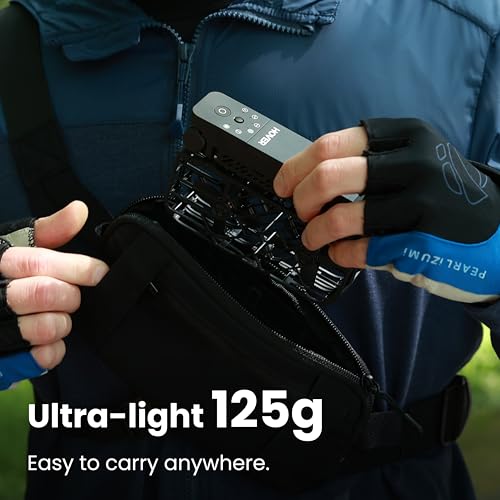
The HOVERAir X1 package provides a compact, ready-to-deploy aerial camera unit designed with an enclosed structural frame that prioritizes direct-contact safety and immediate operational readiness straight out of the box.
- Foldable airframe engineered from a composite blend of aluminum, nylon, and high-impact plastic
- Fully enclosed aerodynamic propeller safety cages designed for safe palm launch and retrieval
- CMOS optical imaging sensor supporting up to 2.7K video recording and 12-megapixel still capture
- Integrated 32GB internal storage array for direct onboard media caching
- Triple stabilization architecture incorporating mechanical stabilization, electronic image stabilization, and Visual Inertial Odometry
- Rechargeable 1050 mAh lithium-polymer flight battery
- HOVER X1 mobile utility application providing flight path configuration, manual Wi-Fi virtual stick control, and live video downlink
Key Specifications
| Hardware Specification | Manufacturer Rating |
|---|---|
| Optical Sensor Type | CMOS Sensor |
| Maximum Video Capture Resolution | 2.7K at 30 frames per second, 1080p HDR |
| Video Output Resolution | 1920×1080 Pixels |
| Effective Still Image Resolution | 12 Megapixels |
| Image & Video Formats | JPEG, PNG; MP4 Video |
| Stabilization System | Triple Stabilization with Visual Inertial Odometry (VIO) |
| Onboard Media Storage | 32GB Internal Storage (non-expandable) |
| Battery Chemistry & Capacity | Lithium Polymer, 1050 mAh |
| Control & Connectivity Protocol | Wi-Fi (App Control via Android / iOS) |
| Maximum Operational Range | Up to 5 km (listing specification) |

Autonomous Tracking Speed and Sports Performance
The operational core of the HOVERAir X1 is its intelligent follow-me camera system, which relies on advanced visual detection algorithms rather than wearable GPS beacon tags. By processing visual information through its onboard computing pipeline, the aircraft detects the human form, locks its orientation onto the subject, and dynamically adjusts its motor output to maintain subject framing. According to manufacturer specifications, the tracking engine supports following speeds of up to 15 mph. This upper threshold positions the aircraft well for activities such as casual jogging, skateboarding, and low-to-moderate speed trail cycling, giving solo athletes an automated tracking angle that previously required a dedicated human camera operator.
When deploying the hoverair x1 for sports, understanding the mechanical boundaries of the 15 mph limit is critical. While 15 mph handles standard running paces and flat-ground skating smoothly, high-speed downhill road cycling or aggressive sprint acceleration will exceed the craft’s tracking envelope. If the target subject outpaces the visual acquisition field, the unit will arrest forward momentum and hover in place rather than flying blindly forward. Readers familiar with ground-based robotic trackers, such as the autonomous movement observed in the rola mini robot, will recognize the importance of keeping the subject within the optical sensor’s central field of view to prevent target loss during sharp turns.
To assist tracking reliability in dynamic outdoor environments, the airframe incorporates Visual Inertial Odometry (VIO) technology. VIO combines optical ground-texture cameras with onboard inertial measurement sensors, calculating real-time spatial positioning without relying solely on satellite navigation signals. This visual positioning system allows the craft to execute stable follow runs beneath tree canopies, through open building breezeways, and in urban settings where satellite signals often degrade. The resulting tracking speed stability remains predictable across flat surfaces and light inclines, provided ambient light levels remain sufficient for the optical tracking cameras to contrast the subject against the background.
Camera Stabilization and Video Resolution Limits
The optical assembly of the HOVERAir X1 is built around a CMOS sensor capable of capturing video at 2.7K at 30 frames per second, as well as 1080p High Dynamic Range (HDR) video. For still imagery, the camera records 12-megapixel photos in standard JPEG and PNG formats. While many high-end manual drones target cinematic 4K resolution at high bitrates, the hoverair x1 video resolution balance is optimized for fast mobile editing and immediate social sharing. The maximum video output resolution of 1920×1080 pixels ensures broad playback compatibility across mobile platforms, providing crisp detail for personal vlogging, vacation reels, and sports recaps without demanding massive desktop rendering pipelines.
Image stability during flight is handled through an integrated triple stabilization system. This multi-tier configuration pairs mechanical axis correction with electronic image stabilization (EIS) algorithms, backed continuously by the positional awareness of the Visual Inertial Odometry sensors. Because the airframe experiences constant motor vibrations and subtle aerodynamic buffeting during high-speed forward movement, the electronic system crops and shifts pixel borders rapidly to compensate for roll, pitch, and yaw movement. The practical outcome is a level horizon and smooth panning during standard automated movements, preventing the micro-jitter often seen in lightweight un-stabilized action cameras.
However, users must account for physical hardware limits when flying in non-ideal conditions. The camera uses a fixed-lens CMOS arrangement without physical aperture adjustment, meaning shutter speed and ISO are handled automatically to manage dynamic range. In bright daylight, high contrast transitions between direct sunlight and deep forest shadows can challenge exposure balance, though the 1080p HDR mode helps retain highlight detail in clouds and skin tones. Furthermore, because high wind forces the airframe to tilt heavily into the breeze to maintain position, the mechanical stabilization can hit its physical axis limit in moderate gusts, introducing occasional frame distortion if operated outside calm environmental parameters.

Internal Storage Architecture and App Compatibility
A notable architectural departure from standard consumer camera drones is the onboard memory design. The hoverair camera x1 internal storage features 32GB of integrated flash memory soldered directly to the mainboard, completely eliminating the external micro-SD card slot. This design provides structural simplification, ensuring that file write errors caused by card vibration or incompatible read-write bus speeds cannot disrupt recording. For daily creator workflows, a 32GB internal storage allocation accommodates multiple flight sessions of 2.7K and 1080p MP4 recordings before requiring manual offloading to a primary workstation or mobile phone.
Media retrieval and hardware management occur primarily through the companion HOVER X1 app. In terms of hoverair x1 app compatibility, the software client requires mobile devices running Android 10.0 and above, or iOS 12.1 and above. The mobile application creates a direct local Wi-Fi connection with the drone, enabling real-time preview monitoring, virtual stick manual piloting, flight mode customization, and swift file downloads. Transferring files wirelessly to modern mobile platforms, such as the samsung galaxy a17 5g smart phone, 128gb, large amoled, high-res camera, durable design, super fast processing ecosystem, allows creators to trim, edit, and upload media straight to platforms like Instagram or Facebook without carrying personal laptops into the field.
While wireless downloading is convenient, users can also retrieve media files by connecting the aircraft directly to a Mac or PC via a standard physical data cable. The onboard 32GB memory mounts as an external mass storage drive, allowing direct dragging and dropping of raw MP4 video and 12-megapixel still assets. The primary operational trade-off of this internal storage architecture is non-expandability. If you fill the 32GB buffer during a long day in the backcountry without an active mobile device or laptop to clear space, you cannot simply swap in a fresh memory card to continue shooting, making systematic file offloading between flights a necessary habit.

Battery Life and Automated Flight Paths
The aircraft draws power from a removable 1050 milliamp-hour (mAh) lithium-polymer battery pack designed specifically for rapid latching onto the top chassis. Regarding overall hoverair x1 battery life, the listing does not specify the exact minute runtime per individual cell. Instead, the operational model is built around short, targeted autonomous capture routines. Rather than lingering in the air for lengthy manual reconnaissance, the craft is designed to launch from your palm, execute a specific pre-programmed trajectory, capture the required cinematic angle, and return immediately to your hand, repeating this sequence several times across a single charge cycle.
To maximize this operational window, the system provides several pre-programmed flight paths selectable directly from physical chassis buttons or through the mobile software interface:
- Hover Mode: The drone lifts vertically and remains locked at a fixed altitude and position, acting as an aerial tripod that pans to keep the subject centered
- Follow Mode: The aircraft tracks the user from behind or in front at speeds up to 15 mph, dynamically following movement through terrain
- Zoom Out: The craft faces the user and flies upward and backward along an angled path, capturing an expanding view of the surrounding landscape
- Orbit: The camera maintains focus on the subject while revolving smoothly in a 360-degree circular perimeter at a predetermined distance
- Bird’s Eye: The drone ascends vertically while pointing its CMOS sensor directly downward, delivering a perpendicular top-down perspective
- Manual Control: The user takes directional control through virtual sticks within the smartphone application, navigating custom flight paths via Wi-Fi
These automated sequences remove the mental overhead of framing complex shots while moving, allowing solo creators to focus on their physical activity. Unlike passive outdoor vision systems like the reolink argus 4 pro solar that rely on static vantage points, the HOVERAir X1 actively repositions itself in three-dimensional space to track physical movement. However, because the 1050 mAh battery delivers power to four brushless motors, onboard video encoders, and continuous visual computing processors simultaneously, carrying additional battery packs is essential for extended production days away from charging outlets.
HOVERAir X1 Pros and Cons
Pros
- Fully enclosed propeller cages ensure safe close-range operation
- Autonomous visual follow-me tracking up to 15 mph
- Integrated 32GB internal storage eliminates micro SD cards
- Triple stabilization system with Visual Inertial Odometry
- Compact folding airframe built with aluminum and nylon
- Diverse automated flight paths including Orbit and Bird’s Eye
Cons
- Maximum video capture resolution capped at 2.7K at 30fps
- Non-expandable internal storage without memory card slot
- Tracking envelope limited to activities below 15 mph
- Flight duration limited by 1050 mAh battery capacity
Is the HOVERAir X1 Worth It
Determining whether the HOVERAir X1 is worth it depends on whether your production workflow aligns with automated personal tracking or traditional manual piloting. If you are a solo content creator, trail runner, cyclist, or traveler seeking an autonomous flying tripod that fits inside a jacket pocket, this device excels. The combination of full propeller safety cages, palm-launch functionality, and automated flight paths allows you to capture dynamic tracking footage without needing a second person or complex dual-stick controller setups. It fulfills the promise of a zero-friction personal cameraman for creators who prioritize quick, reliable dynamic shots over deep flight customization.
Conversely, the HOVERAir X1 is not built for conventional aerial cinematography enthusiasts who demand long-range landscape exploration, raw D-Log color grading, or 4K 60fps recording formats. With its maximum capture resolution capped at 2.7K at 30fps and standard 1080p output, cinema professionals working on large-format commercial projects will find its sensor pipeline limited. Furthermore, while the technical specification lists a maximum range of up to 5 km under ideal wireless conditions, the airframe’s physical size, reliance on Wi-Fi control protocols, and short-duration battery architecture mean its true practical utility remains within close-range proximity of the operator.
Ultimately, the value of the platform lies in its specialized utility. By eliminating the fear of exposed spinning blades and stripping away complex piloting menus, it empowers individuals to capture dynamic third-person perspectives effortlessly. For lifestyle videographers, action sports enthusiasts operating under 15 mph, and digital creators who want immediate social media turnaround without dealing with SD card adapters or bulky carry cases, the HOVERAir X1 offers an exceptionally focused and capable automated filming platform.
FAQ
What is the maximum tracking speed of the HOVERAir X1?
The HOVERAir X1 supports an autonomous following speed of up to 15 mph. This speed is ideal for tracking moderate athletic activities such as running, skateboarding, hiking, and casual cycling. If the user exceeds 15 mph, the aircraft will lose visual lock and safely hover in place rather than continuing forward at unsafe speeds.
Does the HOVERAir X1 require a separate micro SD card for recording?
No, the drone does not use external micro SD cards. It features 32GB of built-in internal storage that records video and photo assets directly to onboard memory. Recorded media can be downloaded wirelessly to your smartphone using the HOVER X1 app or transferred to a desktop computer via a physical cable connection.
Which mobile operating systems are compatible with the HOVER X1 app?
The HOVER X1 mobile application requires a smartphone running Android 10.0 or higher, or iOS 12.1 or higher. The device connects to the drone using a direct Wi-Fi network connection to facilitate live video monitoring, flight path configuration, manual control, and firmware updates.
What automated flight paths can the HOVERAir X1 perform?
The aircraft includes several pre-programmed flight paths that can be initiated directly from the hardware buttons or mobile app. These flight modes include Hover, Follow, Zoom Out, Orbit, and Bird’s Eye. Additionally, users can select Manual Control mode to fly the drone using virtual directional sticks within the smartphone application.
What video resolution does the HOVERAir X1 capture?
The onboard CMOS camera captures video at a maximum resolution of 2.7K at 30 frames per second, as well as 1080p HDR video. Captured media outputs at 1920×1080 pixels in standard MP4 format, stabilized by a triple stabilization system combining mechanical, electronic, and visual inertial odometry technologies.
See the current listing on Amazon
Specifications on this page are read from the product listing. Ratings are the average left by Amazon buyers.