As Amazon Associates, we earn from qualifying purchases. This means we may receive a small commission at no extra cost to you if you click through and make a purchase.

- Brand
- eufy Security
- Buyer rating
- 4.9 out of 5
- Overwhelmingly positive, average of Amazon buyer ratings
Selecting the right outdoor surveillance hardware requires balancing continuous power delivery against optical precision and ecosystem integration. The eufy SoloCam E30 addresses this operational challenge by pairing a 2K resolution sensor with an integrated SolarPlus panel and motorized pan-and-tilt tracking. For property owners looking to monitor yards, driveways, or perimeter fences without managing battery recharging cycles or recurring cloud fees, this camera provides a targeted set of hardware capabilities designed for sustained outdoor deployment. The device functions either as an independent standalone monitor or as an integrated endpoint inside a broader home security network.
Before purchasing, buyers must verify whether its physical solar intake threshold, single-band wireless configuration, and local storage mechanisms align with their property layout. This technical breakdown examines the verifiable hardware characteristics of the camera, covering its light-gathering f/1.6 optics, motorized mechanical pan capabilities, on-device artificial intelligence tracking, and dual compatibility with centralized hub architectures. By evaluating real-world deployment parameters, solar exposure expectations, and ecosystem considerations, this guide provides the technical data needed to confirm whether this hardware matches your surveillance criteria.
What You Get With the eufy SoloCam E30
The retail package and hardware profile of the eufy SoloCam E30 center on off-grid outdoor deployment with integrated solar recharging and onboard processing. Built as an outdoor bullet-style camera in a white finish, the system includes the core mechanical and electrical elements required for immediate overhead mounting:
- Integrated 2K Optical Unit: Features a high-clarity 2K sensor coupled with an f/1.6 aperture lens engineered to capture detailed video streams in MPEG-4 format during day and night surveillance sessions.
- Removable Solar Panel Assembly: Utilizes SolarPlus engineering designed to maintain ongoing battery levels with as little as two hours of direct daily sunlight under normal operating conditions.
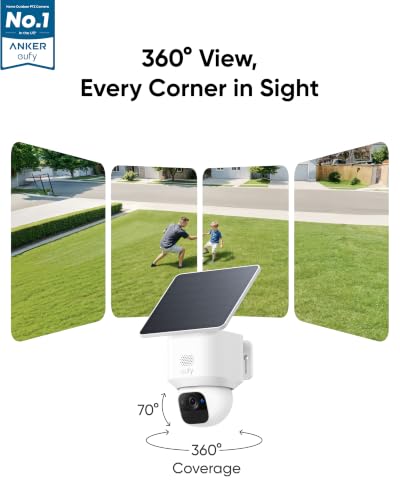
- 360-Degree Motorized Vision Mechanism: Provides motorized panning that delivers a complete 360-degree field of view to eliminate fixed-lens blind spots around structural perimeters.
- On-Device AI Detection Engine: Incorporates edge-based intelligence to automatically detect, classify, and track moving humans, moving vehicles, and critical motion events within view.
- Onboard MicroSD Storage Slot: Supports expandable local video storage using standard microSD cards up to 128 GB capacity without imposing monthly subscription tiers (microSD card not included).
- Dual HomeBase Wireless Interface: Connects to HomeBase S380 for expanded artificial intelligence processing and multi-terabyte storage arrays, or HomeBase S280 for grouped security controls.
- Ceiling Mount Hardware: Includes dedicated screw-in ceiling mounting hardware engineered specifically for rigid overhead structural anchoring.
Key Specifications
| Hardware Attribute | Published Specification |
|---|---|
| Video Resolution | 2K Clarity (MPEG-4 capture format) |
| Lens Aperture | f/1.6 |
| Rotational Coverage | 360-degree pan field of view |
| Power Architecture | Battery powered with removable SolarPlus solar panel |
| Solar Exposure Requirement | 2 hours daily direct sunlight for continuous operation |
| Local Storage Capacity | MicroSD slot supporting up to 128 GB (card not included) |
| Central Hub Compatibility | HomeBase S380 and HomeBase S280 |
| Wireless Connectivity | Wi-Fi 2.4 GHz only, Bluetooth |
| Mounting and Form Factor | Ceiling mount screw-in bullet form factor |
| Smart Home Control | Amazon Alexa, Smartphone App, Push Button, Voice |
Solar Harvesting and Continuous Power Architecture
The standout operational feature outlined in the eufy solo cam e30 specs is its self-replenishing power architecture, marketed as Forever Power. The unit integrates a removable solar panel that feeds energy directly into an internal rechargeable battery cell. According to official manufacturer parameters, achieving self-sustaining operation requires approximately two hours of direct, unobstructed sunlight per day under standard SolarPlus operating conditions. While the manufacturer listing does not specify the exact milliamp-hour (mAh) capacity of the internal battery or the peak wattage output of the solar panel, the operational premise relies on the photovoltaic cell replenishing the energy depleted by daytime motion events and overnight infrared monitoring.
Analyzing real-world eufy solo cam e30 solar performance requires understanding environmental positioning. Because the panel is removable, users have greater flexibility in angling the photovoltaic surface toward southern exposures compared to fixed-body solar units. When evaluating practical eufy solocam e30 battery life, local weather patterns play a definitive role. Extended stretches of heavy cloud cover, winter overcast, or installations under deep architectural overhangs will degrade the rate of charge. In scenarios where direct sunlight falls short of the two-hour benchmark, the internal battery bridges the operational gap, though frequent triggering will gradually deplete reserves until solar capture recovers or manual charging takes place.
Power management is also intrinsically linked to the alert mechanism of the camera. The listing explicitly classifies the alert type as motion-only, meaning the sensor system remains in an optimized standby state until triggered by physical activity. Unlike continuously recording line-powered hardware such as the eufy floodlight cam e340, the battery-and-solar configuration is intentionally tuned for event-driven surveillance. This selective wake-up protocol ensures that the energy budget remains balanced, preventing the motor assemblies and wireless transmitters from exhausting the onboard power cell during periods of low activity.

Optical Resolution and Mechanical Tracking Coverage
Visual fidelity on the camera is anchored by an f/1.6 aperture lens delivering eufy solocam e30 2k resolution encoded in MPEG-4 format. In optical engineering, an f/1.6 aperture represents a wide physical opening relative to focal length, which allows significantly more ambient light to strike the image sensor compared to narrower f/2.0 or f/2.4 lenses commonly found in budget outdoor cameras. This light-gathering capacity directly benefits low-light and nighttime imaging, preserving contrast and fine edge sharpness when tracking subjects through shadowed yards or dim driveway perimeters. Although the listing does not specify the precise frame rate or pixel grid dimensions, the 2K designation guarantees a substantial resolution increase over conventional 1080p surveillance feeds.
Beyond static imaging, the camera incorporates motorized pan capabilities delivering a complete 360-degree field of view. With integrated eufy solo cam e30 360 tracking, the internal motor assembly actively pans horizontally across its axis to follow moving subjects in real time. Rather than relying on a static ultra-wide lens that introduces heavy fisheye distortion along the periphery, the mechanical drive rotates the optical center directly toward the disturbance. While users looking for dedicated dual-camera zoom capabilities might evaluate dual-lens platforms like the eufy solo cam s340, the single-lens 360-degree motorized pan on this camera effectively sweeps across broad exterior sectors without leaving static blind angles behind.
Coordinating this motorized tracking is an onboard artificial intelligence detection engine. The camera processes visual data locally to differentiate between humans, moving vehicles, and routine ambient motion events such as swaying branches or wind-blown debris. When a targeted subject crosses the detection zone, the AI instructs the pan mechanism to follow the vector of movement across the monitored space. This real-time tracking prevents subjects from slipping out of the camera’s primary line of sight, capturing a continuous motion narrative rather than isolated snapshot clips at the frame edge.

HomeBase Integration and Local Storage Options
Storage flexibility and network topology represent major decision points for any outdoor security deployment. For standalone installations, eufy solo cam e30 local storage operates via an onboard microSD card slot supporting memory cards up to 128 GB. Because the recording loop writes directly to the local card, users avoid recurring subscription charges and retain immediate control over their surveillance data. However, prospective buyers should note that the physical microSD card is not included in the retail package and must be sourced separately before local clip archiving can commence.
For advanced network installations, evaluating eufy solocam e30 homebase 3 compatibility reveals substantial expansion opportunities. The camera features dual compatibility with both the HomeBase S380 and the HomeBase S280 centralized hubs. Integrating the camera with HomeBase S380 unlocks enhanced artificial intelligence processing and provides access to multi-terabyte expandable local storage drives. This hub integration consolidates multiple camera feeds into a centralized repository, eliminating the risk of data loss if an outdoor camera is physically tampered with or removed. For users managing broader multi-room setups that incorporate indoor units like the eufy indoor cam s350, a centralized HomeBase provides a unified management environment.
A critical technical caveat highlighted in the product specifications involves the handoff protocol between hubs. The manufacturer explicitly notes that users must unbind the camera from its existing configuration before migrating between a HomeBase S280 and a HomeBase S380. Failing to unbind the device in software prior to hardware reassignment can prevent the new hub from recognizing the camera feed. While HomeBase S280 provides stable group control systems and in-house storage, users prioritizing maximum storage retention and advanced video intelligence will find the S380 pairing to be the superior ecosystem route.

Wireless Connectivity and Physical Mounting Requirements
Network communication on the camera is defined by specific protocol boundaries. The wireless transceiver operates exclusively on eufy solocam e30 wifi 2.4ghz networks, with no support for 5 GHz Wi-Fi frequencies. While modern dual-band routers support both frequencies, users must ensure that their router broadcasts a distinct or compatible 2.4 GHz SSID during the initial pairing process. The 2.4 GHz frequency provides superior penetration through exterior brick, stucco, and wood framing compared to higher frequency signals, which is vital for maintaining steady transmission to an outdoor security antenna over extended distances.
Initial device configuration and localized pairing utilize onboard Bluetooth protocols, allowing the smartphone application to detect and calibrate the camera before it is hoisted into position. Control methods span mobile app management, voice control via Amazon Alexa, and an integrated physical push button on the chassis. Alexa integration enables live stream casting to compatible smart displays and routine voice management, anchoring the camera within mainstream connected home setups without requiring proprietary smart screens.
Physical installation requires careful evaluation of structural surfaces. The hardware features a bullet-style form factor finished in white, engineered strictly for screw-in ceiling mount installations. This specific overhead mounting geometry means that the bracket is optimized for under-eave, soffit, or porch ceiling attachments. Attempting to mount the unit flush against a vertical exterior wall without an aftermarket adapter may limit the mechanical clearance of the 360-degree pan mechanism. Proper screw-in anchoring into solid structural substrate ensures the camera resists wind vibration, maintaining optical stability for motion detection algorithms.
eufy SoloCam E30 Pros and Cons
Pros
- 2K clarity with f/1.6 aperture lens
- Removable solar panel with SolarPlus technology
- Motorized 360-degree pan tracking
- Local storage up to 128 GB without subscription fees
- Dual compatibility with HomeBase S380 and S280
- Onboard AI detection for people and vehicles
Cons
- MicroSD card not included in package
- Supports only 2.4 GHz Wi-Fi networks
- Requires ceiling mount screw-in installation
- Motion-only alert type without continuous recording
Is the eufy SoloCam E30 Worth It
Determining if the eufy SoloCam E30 is worth it depends on your physical property layout, wireless infrastructure, and appetite for recurring cloud fees. If you require an autonomous outdoor surveillance camera capable of monitoring open zones such as detached garages, wide driveways, or rear patios without running electrical wiring, the hardware design delivers exceptional standalone value. The pairing of 2K video clarity with an f/1.6 aperture lens and motorized 360-degree tracking resolves the primary shortcoming of traditional fixed-angle solar cameras, which frequently leave wide blind zones unmonitored.
However, the device presents specific operational constraints that certain buyers must weigh carefully. If your installation location is located under dense, continuous shade or lacks an unshaded ceiling or soffit mounting point, meeting the two-hour daily sunlight requirement will prove difficult. Furthermore, users operating purely on 5 GHz Wi-Fi mesh nodes without 2.4 GHz backward compatibility will encounter network pairing roadblocks. The absence of an included microSD card also requires an immediate secondary purchase if you plan to operate the camera in standalone mode without a centralized HomeBase hub.
Ultimately, for homeowners who already own or plan to deploy a HomeBase S380 or HomeBase S280 hub, the unit integrates seamlessly into a cohesive, subscription-free security infrastructure. The ability to offload recorded clips to high-capacity local drives while benefiting from on-device vehicle and human tracking makes it an analytically sound hardware choice for long-term outdoor perimeter monitoring.
FAQ
Does the eufy SoloCam E30 support 5 GHz Wi-Fi networks?
No. The specifications explicitly state that the camera supports only 2.4 GHz Wi-Fi connections. If you operate a dual-band or tri-band home router, you must connect the camera to the 2.4 GHz network band to ensure proper connectivity and streaming performance.
How much daily sunlight does the solar panel require to maintain battery power?
The camera requires approximately two hours of direct daily sunlight to stay continuously charged under standard SolarPlus operating conditions. If the removable solar panel is placed in deep shade or subjected to prolonged periods of overcast weather, the internal battery will gradually deplete until sunlight exposure resumes.
Is a microSD card included with the camera for local storage?
No. While the camera features an onboard microSD card slot that supports storage capacities up to 128 GB with no monthly subscription fees, the physical microSD card is not included in the package and must be purchased separately.
Can the camera connect to both HomeBase S380 and HomeBase S280?
Yes. The camera offers dual compatibility with both HomeBase S380 and HomeBase S280. Connecting to HomeBase S380 enables advanced AI capabilities and terabyte-scale storage, while HomeBase S280 supports group control systems. You must unbind the camera from one HomeBase before connecting it to the other.
What type of mounting does the camera support?
The manufacturer listing specifies a ceiling mount form factor with screw-in installation. The bracket is designed for secure overhead mounting beneath eaves, soffits, or porch ceilings to provide proper clearance for its 360-degree pan mechanism.
See the current listing on Amazon
Specifications on this page are read from the product listing. Ratings are the average left by Amazon buyers.


