As Amazon Associates, we earn from qualifying purchases. This means we may receive a small commission at no extra cost to you if you click through and make a purchase.

- Brand
- Nebula
- Our score
- 8.8 out of 10
- Very positive
The Nebula Capsule 3 Laser is engineered for mobile entertainment enthusiasts who demand true high-definition visuals without carrying bulky projection equipment. Built around a specialized laser illumination source and a 1080p DLP imaging engine, this miniature smart projector targets users who prioritize compact portability alongside optical sharpness. With a form factor roughly the size of a soda can, it aims to replace traditional bedside televisions, enhance outdoor camping setups, and provide a self-contained cinematic display wherever flat surfaces exist. If your objective is to project streaming content in dim or dark rooms without tethering yourself to an electrical wall outlet, this compact unit offers a dedicated solution that consolidates an operating system, audio reproduction, and battery power into a single cylindrical chassis weighing just two pounds.
Evaluating this portable display requires a thorough look beyond standard marketing claims, focusing on real-world optical efficiency, runtime calculations, and hardware thermal characteristics. In this detailed breakdown, we assess the performance of its laser light engine, analyze how the 300 ANSI nebula capsule 3 laser lumens output interacts with projection distance, and review the battery depletion curves during video and music playback. We also examine system connectivity across physical and wireless interfaces, evaluate the integrated Google TV software platform, and weigh the functional trade-offs inherent in ultra-portable projection design to help you determine if this model aligns with your technical requirements.
What You Get With the Nebula Capsule 3 Laser
The retail package and foundational architecture of the projector focus on delivering a self-contained theater experience within an ultra-compact cylindrical profile designed for rapid deployment.
- Nebula Capsule 3 Laser portable DLP projector finished in matte black.
- Integrated laser illumination light source delivering 300 ANSI lumens with a rated operating life of 30000 hours.
- Native 1920 x 1080 display architecture utilizing DLP projection technology.
- Built-in rechargeable battery supporting up to 2.5 hours of movie playback or 8 hours of standalone audio operation.
- Integrated 8W Dolby Digital sound system housed directly inside the portable cylinder.
- Onboard smart television platform featuring Google TV with native Google Assistant, Google Cast, and officially licensed Netflix support.
- Comprehensive port array including HDMI, USB, Type-C power input, and an auxiliary audio output.
- Wireless transmission suite providing Wi-Fi, Bluetooth audio streaming, and smartphone screen mirroring.
- Chassis hardware button controls alongside a standard tripod mount socket integrated into the base.
Key Specifications
| Specification Attribute | Technical Detail |
|---|---|
| Projection Technology | DLP (Digital Light Processing) |
| Native Resolution | 1920 x 1080 pixels (Full HD) |
| Light Source Type | Laser Light Source |
| Light Source Brightness | 300 ANSI Lumens |
| Contrast Ratio | 500:1 |
| Light Source Lifespan | 30,000 Operating Hours |
| Maximum Image Size | 120 Inches |
| Maximum Throw Distance | 3.18 Meters |
| Integrated Audio Output | 8 Watts (Dolby Digital) |
| Battery Runtime | 2.5 Hours Video / 8 Hours Music |
| Power Input Specification | Type-C Power Delivery (20 Volts) |
| Form Factor and Weight | Portable Cylinder, 2 lb (900 grams) |

Optical Engine Performance and 1080p DLP Clarity
A central consideration when analyzing the capsule 3 laser specs is how its laser light source differentiates itself from conventional LED-driven pocket projectors. The incorporation of a solid-state laser engine allows the unit to generate 300 ANSI lumens while maintaining a tiny, highly efficient thermal footprint. Unlike standard lamps or diffused LED arrays, the coherent light of a laser diode produces superior color saturation and uniform optical density across the entire projection field. This efficiency prevents the severe luminance drop-off at image corners that frequently plagues mini projectors, maintaining crisp detail whether you cast a modest 40-inch display or expand to a larger canvas.
Resolution fidelity is governed by the capsule 3 laser 1080p dlp system, which renders a native 1920 by 1080 progressive image without downsampling high-definition source files. Many miniature projectors accept a 1080p input signal while secretly downscaling to a 720p or 480p micro-mirror array, introducing blur to on-screen text and soft edges in video playback. Because this unit relies on true 1080p micro-mirrors, fine details, user interfaces, and subtitle typography remain sharp. The precision optics function similarly to focused diode systems evaluated in technical hardware analyses like the falcon a1 pro, where tight beam divergence ensures energy remains concentrated on the target plane rather than scattering.
Throw geometry directly impacts picture vibrancy and installation flexibility. While the listing notes a maximum image size of 120 inches at a maximum throw distance of 3.18 meters, the listing does not specify a fixed numerical capsule 3 laser throw ratio figure. However, basic optical geometry indicates that pushing the projector to its 3.18-meter boundary spreads the 300 ANSI lumens across a vast area, noticeably reducing perceived luminance. To maximize the 500:1 contrast ratio and maintain punchy black levels, setting the projection throw between 1.5 and 2.2 meters—yielding an image between 60 and 80 inches—produces the most balanced optical clarity in real-world viewing conditions.
Battery Endurance and Power Delivery Charging Flexibility
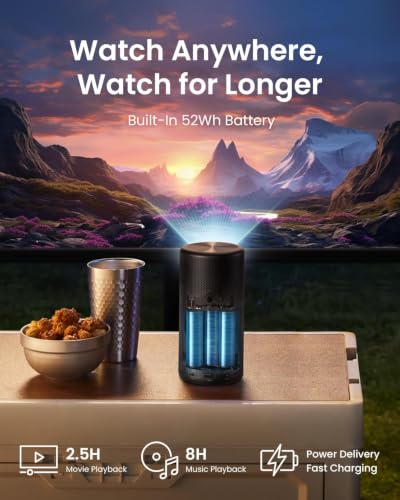
Portable projection hinges entirely on power management, and the capsule 3 laser battery life is calibrated around typical feature-length film durations. The integrated battery is engineered to deliver up to 2.5 hours of continuous video playback on a complete charge, which accommodates most standard movies without requiring an external cable run. For audio-only scenarios where the laser engine remains unpowered, the device can operate as a dedicated Bluetooth speaker for up to 8 hours. However, users should understand that operating at maximum brightness settings or transmitting heavy network streaming traffic over Wi-Fi will draw down cell reserves faster than local media playback at moderate output levels.
The charging system relies on modern power protocols rather than proprietary barrel adapters, significantly improving field practicality. Featuring capsule 3 laser power delivery charging over a standard USB Type-C port, the projector operates on a 20-volt input profile. This standard allows users to recharge the internal battery or run the device continuously using standard high-output USB-PD power banks and wall chargers. Mobile cinephiles are no longer constrained by the 2.5-hour internal capacity, as connecting a 65W or higher PD battery pack can easily double or triple movie runtimes during multi-feature backyard screenings or extended trips off the grid.
Thermal regulation during charging and projection represents an essential engineering metric. Because the internal chassis must dissipate heat generated by both the DLP imaging block and the 20V charging circuit, the projector incorporates internal active airflow. Drawing power at an operational wattage rating of 8 watts, the internal thermal management keeps the chassis cool without generating intrusive mechanical noise that could overpower dialogue. Just as high-performance diode arrays demand careful heat sink calibration in platforms like the creality falcon a1, this compact projector balances compact surface area with continuous convective cooling to protect optical alignment over its 30000-hour operational life.

Outdoor Projection Capabilities and Ambient Light Limitations
Understanding nebula capsule 3 laser outdoor use requires a realistic evaluation of ambient light and environmental optics. The optical engine provides a certified output of 300 ANSI lumens, a figure that is remarkably potent for a two-pound cylinder but insufficient to combat direct daylight or heavy twilight. For outdoor movie sessions, projection should be reserved for nautical twilight, civil dusk, or full nighttime darkness. Introducing ambient light sources such as patio lamps, campfires, or municipal streetlights into the optical path will wash out the 500:1 native contrast ratio, turning deep shadows into murky gray planes and obscuring shadow details.
Chassis mechanics are well-suited for outdoor deployment thanks to the standard tripod mount built into the bottom of the enclosure. Rather than balancing the projector on rocks, coolers, or uneven picnic tables, users can secure the unit to any standard photographic tripod to achieve accurate elevation and pitch. Stable mechanical alignment is critical for optical clarity, echoing the alignment rigor seen in specialized hardware maintenance tools such as the laser tools 6938, where rigid mounting prevents vibration and optical drift. Paired with a proper tripod, the 900-gram weight ensures the setup remains stable even under moderate evening breezes.
Audio delivery outdoors is another critical consideration for mobile installations. The unit features an integrated 8W speaker running Dolby Digital processing, designed to project sound outward from its cylindrical acoustic chamber. In enclosed rooms, this 8-watt driver produces surprising volume and vocal intelligibility; however, open outdoor spaces lack reflective walls, causing rapid sound dissipation. While the onboard driver is adequate for a small group seated close to the projector, larger outdoor gatherings will benefit from utilizing the auxiliary audio out port or Bluetooth connectivity to route soundtracks to an external amplified speaker system.

Operating System Performance and Hardware Connectivity
A frequent pain point among portable projectors is software fragmentation and restricted digital rights management, but the nebula capsule 3 laser netflix integration resolves this problem directly. Unlike many portable Android projectors that require cumbersome workarounds, unauthorized mobile APKs, or secondary thumb drives to display standard definition streams, this model features Google TV with an officially licensed Netflix client. Users can launch Netflix, YouTube, and other streaming platforms directly from the primary user interface using the native remote or the integrated button controls on the chassis, receiving fully certified high-definition playback without resolution downgrades.
Physical I/O flexibility is supported by robust capsule 3 laser hardware connectivity located neatly across the rear lower section of the cylinder. A full-sized HDMI input enables the direct connection of gaming consoles, laptop computers, Blu-ray players, and secondary streaming sticks when independent signal input is needed. The adjacent USB port allows local playback of media files stored on flash drives, accommodating video files when outdoor venues lack Wi-Fi coverage. For legacy audio configurations, the 3.5mm Aux Out jack provides an analog audio link to powered speakers, headphones, or external mixers without wireless latency.
Wireless communication expands setup convenience when physical cables are impractical. The internal radio suite supports dual-band Wi-Fi for buffer-free high-bitrate streaming alongside Bluetooth for wireless audio pairing. Smartphone integration is fully supported, allowing users to cast screens, broadcast personal photos, and mirror compatible mobile apps via Google Cast. Whether controlled through Google Assistant voice commands, smartphone pairing, or manual button presses, the interface remains responsive and eliminates the need to carry external streaming adapters in your travel pack.
Nebula Capsule 3 Laser Pros and Cons
Pros
- Native 1080p DLP laser projection engine
- Compact two-pound travel-ready cylindrical body
- Google TV with officially licensed Netflix
- 20V USB Type-C Power Delivery charging
- Integrated 8W Dolby Digital sound
Cons
- Modest 300 ANSI lumens requires darkness
- Internal battery limited to 2.5 hours video
- Native contrast ratio rated at 500:1
Is the Nebula Capsule 3 Laser Worth It
Determining whether this portable projector justifies an investment depends entirely on how you balance physical dimensions against optical brightness. If you are searching for a projector to serve as a permanent primary home theater display in a room with uncontrolled ambient daylight, the 300 ANSI lumen output will prove underpowered compared to larger, mains-powered home cinema projectors. The compact 2-pound form factor intentionally prioritizes extreme portability, internal battery operation, and low acoustic noise over raw lumen output, making it an unideal candidate for replacing a bright living room television.
Conversely, for campers, frequent travelers, digital nomads, and apartment dwellers who desire a self-contained cinematic setup that packs away into a backpack pocket, the projector represents an exceptional balance of hardware specifications. The fusion of true 1080p DLP clarity, a maintenance-free 30000-hour laser light source, officially licensed Netflix streaming via Google TV, and versatile 20V USB-PD charging sets a high technical benchmark within the miniature category. If you regularly view content in dark rooms, backyard evening setups, or tent sites where portability is paramount, evaluating if the capsule 3 laser is worth it yields a clear affirmative answer.
Ultimately, buyers who recognize the operational boundaries of a 300-lumen laser engine will find immense value in this hardware package. By combining audio, smart streaming software, and lithium-ion power into a chassis that is ninety percent smaller than competing models of equivalent brightness, it eliminates the messy rat’s nest of power bricks, HDMI cables, and streaming sticks. For the mobile cinephile who values grab-and-go convenience without sacrificing high-definition resolution, this compact cylindrical unit proves to be a well-engineered companion.
FAQ
How bright is the Nebula Capsule 3 Laser in ambient lighting?
The projector outputs 300 ANSI lumens from its laser light source, which is calibrated specifically for low-light or fully darkened environments. In rooms with direct sunlight or unshaded lamps, the image will appear washed out, and contrast will suffer. For the best viewing results, use the projector in dark rooms or outdoors after sundown.
Can the Nebula Capsule 3 Laser play Netflix natively?
Yes, the projector runs official Google TV software with an officially licensed Netflix client pre-installed. You can stream content directly through the native interface in high definition without needing to sideload mobile applications, use a secondary computer, or attach an external streaming stick.
What power bank do I need to charge the projector via USB-PD?
The projector requires USB Type-C Power Delivery (PD) charging operating at a 20-volt profile. To recharge the internal battery while in use or extend your playback runtime outdoors, ensure your external power bank supports USB-PD output at 20 volts with sufficient wattage.
Can I use the projector as an external Bluetooth speaker?
Yes, the device supports a dedicated Bluetooth speaker mode that powers down the laser projection engine to conserve energy. In this audio-only operational mode, the integrated 8W Dolby Digital speaker system provides up to 8 hours of continuous music playback on a single battery charge.
What is the maximum screen size supported by the hardware?
The optical specifications support a maximum image size of up to 120 inches at a maximum throw distance of 3.18 meters. While larger projections are physically possible by moving the unit further away, maintaining a distance between 1.5 and 2.2 meters delivers higher perceived brightness and sharper contrast.
See the current listing on Amazon
Specifications on this page are read from the product listing. Scores are out of 10, based on listed specifications and buyer feedback.