As Amazon Associates, we earn from qualifying purchases. This means we may receive a small commission at no extra cost to you if you click through and make a purchase.
- Brand
- Philips
- Buyer rating
- 4.1 out of 5
- Mostly positive, average of Amazon buyer ratings
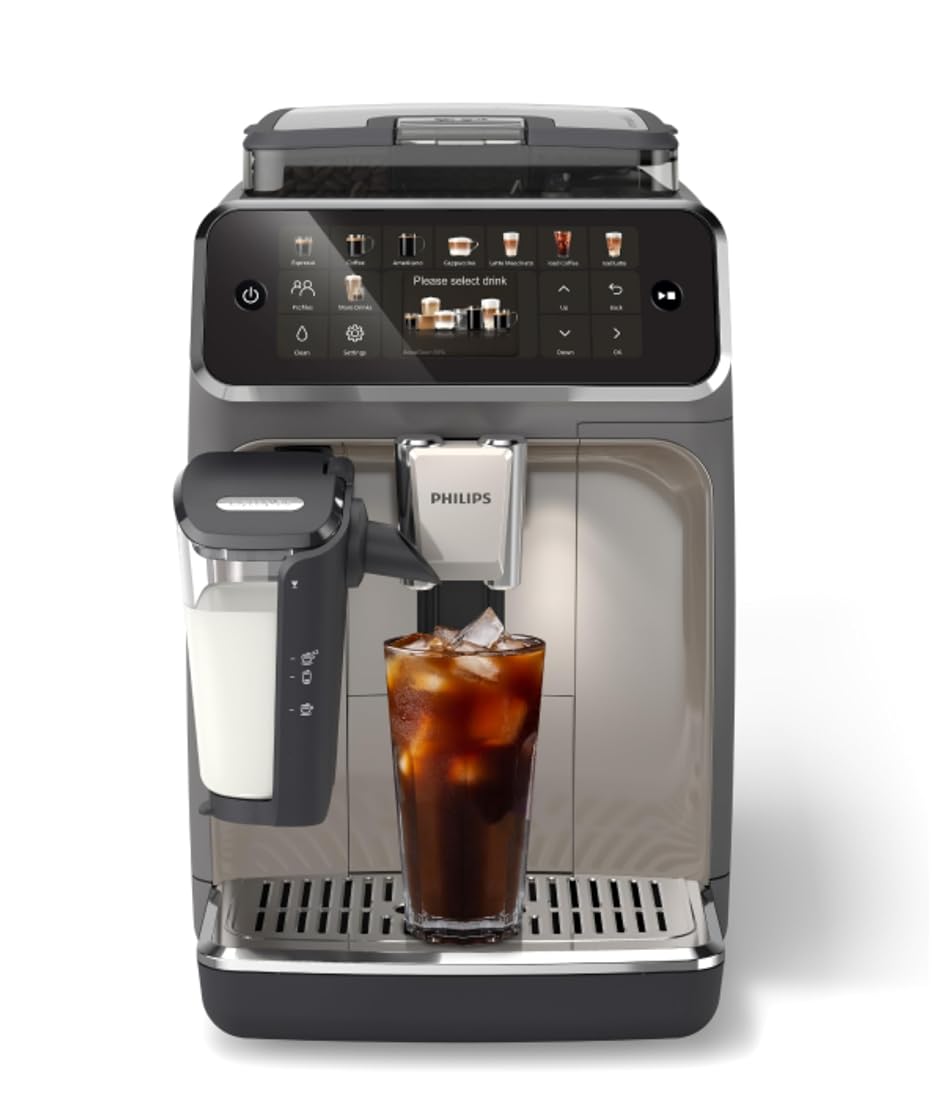
When shopping for a fully automatic coffee system, deciding on the Philips 5500 comes down to whether you prioritize hands-free beverage variety, rapid thermal readiness, and low-friction cleanup over the manual tweaking of traditional espresso hardware. Engineered as an all-in-one counter unit, this machine is aimed directly at households that consume multiple coffee styles throughout the day, spanning standard morning espresso shots, iced beverages, and multi-layered milk drinks. By integrating a 15-bar extraction pump, a built-in bean grinder, an automated mechanical tamping system, and an external tube-free milk frother, the platform automates the entire preparation cycle from raw whole bean to finished drink at the touch of a display icon.
Prospective buyers evaluating the phillips espresso machine 5500 specs need to look past high-level marketing claims and examine the underlying technical realities, including pump dynamics, voltage demands, acoustic insulation metrics, and spatial footprint. For those researching a comprehensive philips 5500 coffee machine breakdown, this analysis provides an exhaustive look at the internal extraction assembly, recipe programming, milk frothing system, physical counter requirements, and scheduled maintenance protocols to determine if this machine fits your daily routine.
What You Get With the Philips 5500
The Philips 5500 package is structured around a fully assembled super-automatic base unit designed for minimal assembly and rapid deployment out of the box. The manufacturer integrates the following core hardware elements and accessories within the system package:
- Fully automatic coffee machine base housing the internal 15-bar pump, 1500-watt thermal block, and built-in grinder mechanism
- LatteGo modular milk frothing carafe composed of three detachable, tube-free components
- 1.8-liter front-loading transparent water reservoir
- AquaClean ion-exchange water filter cartridge rated for up to 5,000 cups of descaling-free operation
- Integrated color touchscreen display preloaded with graphic drink selection tiles and recipe settings
- Secondary bypass doser chute dedicated to pre-ground decaffeinated or specialty coffee
- Removable internal brew group fitted with a metal filter screen for routine rinse servicing
- Removable drip tray assembly with integrated mechanical float indicator and used grounds container
Key Specifications
| Specification Attribute | Technical Detail |
|---|---|
| Pump Pressure | 15 bar maximum output |
| Heating Power Consumption | 1500 watts |
| Electrical Voltage Rating | 230 volts |
| Water Tank Capacity | 1.8 liters |
| Beverage Recipe Presets | 20 pre-programmed selections |
| Machine Dimensions | 9.69″D x 14.61″W x 17.05″H |
| Listed Product Weight | 3.6 pounds |
| User Interface | Color touchscreen display |
| Coffee Input Compatibility | Whole bean hopper and pre-ground bypass chute |
| Filtration System | AquaClean filter with internal metal mesh brew filter |

Extraction Mechanics and the 15-Bar Pressure Pump
The internal brewing mechanics of the machine rely on an integrated grinder paired with the philips 5500 15 bar pump to deliver consistent water displacement through the compacted coffee bed. Super-automatic platforms depend on automated mechanical consistency: once a beverage preset is triggered, the internal grinder processes whole beans, deposits the dose into the internal brew chamber, mechanically tamps the puck with uniform pressure, and initiates water delivery. The 15-bar pump creates sufficient peak pressure head to overcome hydraulic resistance across the finely ground bed, ensuring that volatile aromatic oils and dissolved coffee solids are transferred evenly into the cup without channeling.
For users who switch between caffeinated and decaffeinated roasts throughout the day, the dual input design provides critical flexibility. While the primary hopper feeds the internal grinder for whole bean processing, a dedicated bypass doser allows the user to introduce single servings of pre-ground coffee directly into the brew group. This bypass pathway completely circumvents the grinding stage, letting the 1500-watt heating system and 15-bar hydraulic assembly focus exclusively on thermal stabilization, pre-infusion wetting, and extraction. The internal metal filter screen maintains puck integrity throughout the extraction stroke, preventing fine particulate migration into the cup.
When evaluated against semi-automatic manual machines like the breville barista express espresso machine bes870xl, the automated extraction workflow on this machine eliminates the operator variables that cause inconsistent morning espresso. While traditional semi-automatics require the barista to manually dial in grind size, weigh portafilter output, and apply a calibrated manual tamp, this fully automatic system standardizes every physical variable inside a sealed brew group. The trade-off is manual tactile feedback: you sacrifice manual flow Profiling in exchange for push-button repeatability and automated puck ejection into an internal dump box.

Drink Presets and Interface Customization
A primary selling point across the philips 5500 drink presets catalog is the inclusion of 20 distinct beverage selections directly accessible from the full-color touchscreen interface. Rather than limiting options to classic espresso and black drip-style coffee, the internal recipe matrix spans hot staples—including espresso, long coffee, Americano, cappuccino, latte, and macchiato—alongside specialized iced coffee profiles and hot water dispensing. Each preset automatically calibrates water volume, brewing temperature, and milk ratio according to preset volumetric parameters, removing the guesswork involved in complex layered drinks.
Customization is handled through digital sliders displayed on the responsive color screen. Users can modulate coffee strength across multiple bean intensity levels, tweak liquid dispense volume to fit specific glassware, and alter milk foam density levels to suit personal preferences. The listing documentation highlights user profile memory, noting capabilities between two and four discrete profiles depending on system configuration, allowing multiple household members to save customized parameter sets. Once configured, a user taps their assigned profile tile to pull an exact, customized beverage without resetting individual recipe metrics.
When considering platform iterations like the philips 5500 vs 4300, the expanded preset library and modern graphical interface represent the most tangible day-to-day upgrades. Earlier generations restricted drink variety to roughly half this machine’s capacity and relied on more basic button-and-screen combinations. The updated visual display on this unit shows clear graphical beverage representations that allow users to visually audit the liquid-to-milk ratios before committing to the brew cycle, significantly reducing preparation errors.

LatteGo Milk Frothing and Acoustic Damping
A technical assessment in any philips 5500 lattego review must focus on the mechanical design of the proprietary milk frother. Unlike conventional commercial espresso steam wands or automated carafes that route dairy through internal silicone tubing and complex solenoid valves, the LatteGo system uses a chamber formed by three interlocking external plastic parts. The machine injects high-velocity steam into an open cyclonic mixing chamber, drawing liquid milk upward, blending it with air, and dispensing a micro-foam directly into the cup. Because there are no internal tubes or hidden channels, dairy residue cannot accumulate inside the machine body, eliminating a common vector for bacterial contamination.
Operational volume has long been an issue for super-automatic machines, which typically produce substantial motor whine and grinding resonance. The manufacturer addresses this through its SilentBrew sound shielding architecture, which holds official acoustic certification from Quiet Mark. By surrounding the grinding motor and internal pump with sound-dampening acoustic baffles, the philips 5500 silentbrew noise level is rated at 40% quieter than earlier unshielded Philips models. This acoustic attenuation allows early morning brewing in shared living spaces without the sharp mechanical clatter common to uninsulated bean-to-cup machines.
Thermal responsiveness is similarly enhanced through QuickStart technology, which drastically compresses initial operational delay. The philips 5500 quickstart brew time allows the internal 1500-watt thermal block to reach extraction-ready temperatures within three seconds of system power-on. Compared to platforms like the phillips 4400 fully automatic espresso and cappuccino machine, this rapid thermal recovery minimizes idle power draw and eliminates lengthy warm-up delays, enabling the machine to grind and extract a morning beverage almost immediately after cold startup.

Countertop Dimensions and Daily Maintenance
Assessing kitchen fit requires careful measurement of the philips 5500 dimensions and capacity against your available workspace. The machine measures 9.69 inches in depth, 14.61 inches in width, and 17.05 inches in height. At over 17 inches tall, prospective owners must confirm upper cabinet clearance, especially since the whole-bean hopper and water reservoir access points require top-down space during refills. The water reservoir holds 1.8 liters of water, balancing counter space conservation with sufficient fluid volume to execute multiple consecutive milk drinks, extraction flushes, and rinse cycles before needing replenishment. Note that while the listing specifies an item weight of 3.6 pounds, super-automatic machines of this form factor typically sit firmly in place during pump activation.
Routine philips series 5500 maintenance is split between instantaneous daily rinsing and scheduled component servicing. The LatteGo milk carafe requires no disassembly beyond snapping apart its three plastic components, which can be rinsed under warm running water in roughly 10 seconds or placed on the top rack of a dishwasher. The drip tray and internal spent coffee grounds drawer slide straight out from the front of the unit, featuring mechanical level floats that indicate when accumulated wastewater requires disposal. The internal metal brew group is completely removable from the side maintenance door, allowing weekly full-system rinses to clear coffee oil buildup without chemical backflushing.
Water quality and descaling protocols are managed by the bundled AquaClean filtration cartridge. Operating via ion-exchange resin and microporous water channels, the filter removes suspended mineral ions and micro-contaminants before water enters the internal 1500-watt heating block. When the AquaClean filter is replaced according to machine prompts, the system can deliver up to 5,000 cups of coffee without requiring a manual chemical descaling cycle. This significantly lowers overall maintenance downtime and prevents scale accumulation within the internal 15-bar hydraulic pathways.
Philips 5500 Pros and Cons
Pros
- 20 programmed hot and iced drink presets
- Three-part tube-free LatteGo milk system
- SilentBrew sound shielding certified by Quiet Mark
- QuickStart system ready in three seconds
- AquaClean filter supports 5000 cups descaling-free
Cons
- Listed for 230-volt electrical operation
- Tall 17.05-inch height requires high cabinet clearance
- Touchscreen interface lacks physical tactile buttons
Is the Philips 5500 Worth It
Determining whether the Philips 5500 represents a sensible purchase requires evaluating your beverage consumption patterns against its automated design philosophy. If your household relies on a high volume of milk-based drinks, iced coffees, and quick single-origin espressos, this machine delivers extraordinary functional utility. It completely eliminates the grinding, dosing, tamping, steaming, and extensive wand cleaning steps required by manual espresso gear, delivering finished drinks within minutes through its one-touch touchscreen workflow.
Conversely, the machine is less suited for home baristas who view coffee preparation as a deliberate hobby centered on manual shot profiling and micro-adjustments. The integrated extraction parameters, while adjustable for volume and strength, operate within fixed software guardrails governed by the automated brew group. Additionally, prospective buyers in North America must carefully inspect their home electrical infrastructure: the listing specifies a 230-volt electrical requirement alongside its 1500-watt power draw, meaning standard 120-volt kitchen receptacles will require dedicated electrical accommodation or regional compatibility confirmation before purchase.
Ultimately, is philips 5500 worth it for the shopper demanding maximum drink diversity with absolute minimal cleaning friction? Yes. The combination of 20 programmed recipes, certified SilentBrew noise dampening, 3-second QuickStart readiness, and a tubeless milk frother that cleans in seconds makes the Philips 5500 one of the most mechanically balanced and user-friendly super-automatic platforms currently available in its equipment class.
FAQ
How many drink presets are available on the Philips 5500?
The machine includes 20 pre-programmed drink presets selectable via the color touchscreen. These options cover traditional hot espresso, long coffee, Americano, cappuccino, latte, macchiato, iced coffee variations, and a dedicated hot water dispensing function.
How fast does the Philips 5500 heat up before brewing?
Thanks to the manufacturer’s QuickStart engineering, the machine achieves a ready-to-brew thermal state in 3 seconds from initial power-on. This rapid thermal block response minimizes the preheating wait times common on older espresso hardware.
Can you use pre-ground coffee in the Philips 5500?
Yes, the system features a dedicated bypass doser chute that accepts pre-ground coffee. This allows users to brew decaffeinated or alternative roasts without emptying the primary whole-bean hopper or activating the internal grinder.
How do you clean the LatteGo milk system?
The LatteGo assembly features a tube-free three-part construction without hidden internal channels. It can be completely detached, separated into its three components, and rinsed clean under warm water in approximately 10 seconds, or washed directly in a dishwasher.
What are the counter dimensions and water capacity of the Philips 5500?
The machine measures 9.69 inches deep, 14.61 inches wide, and 17.05 inches tall. It is equipped with a removable front-access water reservoir with an internal fluid capacity of 1.8 liters.
What type of electrical connection does the Philips 5500 require?
According to the product specifications, the machine operates on a 230-volt electrical supply and consumes 1500 watts of power, which users should verify against their domestic outlet infrastructure before installation.
See the current listing on Amazon
Specifications on this page are read from the product listing. Ratings are the average left by Amazon buyers.


