As Amazon Associates, we earn from qualifying purchases. This means we may receive a small commission at no extra cost to you if you click through and make a purchase.

- Brand
- Midea
- Buyer rating
- 4.7 out of 5
- Overwhelmingly positive, average of Amazon buyer ratings
Evaluating a variable-speed cooling system requires separating factory marketing claims from measurable thermodynamic reality. The Midea Duo 14,000 BTU portable air conditioner enters a market crowded with inefficient legacy designs, targeting shoppers who want to know if an advanced inverter system and dual-hose architecture justify upgrading a residential living space. Operating at a nominal 14,000 BTU rating with a 12,000 BTU SACC score, this residential packaged unit is engineered specifically for rooms up to 550 square feet. For homeowners and apartment residents struggling with heavy summer thermal loads, the critical question is whether its variable-speed inverter mechanics, balanced air exchange, and ultra-quiet acoustics deliver tangible improvements over traditional portable cooling appliances.
This technical breakdown inspects the mechanical architecture, energy consumption metrics, and acoustic engineering of the unit to evaluate its real-world performance. We examine the thermodynamics behind the concentric hose-in-hose intake and exhaust ducting, measure the electrical implications of its 1300-watt rotary scroll compressor, and verify its 42 dB minimum sound profile. Throughout this evaluation, we reference performance benchmarks across the portable category, including comparisons against baseline platforms like the dreo 515s portable air conditioner, to determine whether this inverter platform represents the optimal cooling investment for your floor plan.
What You Get With the Midea Duo 14,000 BTU
The factory package provides a complete residential cooling setup engineered for immediate deployment into standard sliding or hung window configurations without requiring aftermarket duct adapters or custom fabrication.
- Midea Duo 14,000 BTU inverter portable cooling unit in a black chassis finish
- Concentric Duo dual hose-in-hose flexible air exhaust and intake duct assembly
- Packaged window installation slider kit with a vertical pull-out bracket system
- Full-function handheld remote control
- Integrated Air Fresh filtration module and secondary dust filter
- Built-in Wi-Fi module supporting iOS and Android smart device management
- Factory-attached 115-volt corded electric power cable
Key Specifications
| Attribute | Specification Detail |
|---|---|
| Cooling Capacity (Nominal / ASHRAE) | 14,000 BTU |
| Cooling Capacity (SACC Rating) | 12,000 BTU SACC |
| Coverage Rating | Up to 550 sq. ft. |
| Compressor Architecture | Rotary scroll variable-speed inverter |
| Minimum Sound Pressure Level | 42 dB |
| Electrical Requirements | 115 volts, corded electric |
| Rated Power Consumption | 1300 watts |
| Seasonal Energy Efficiency Ratio (SEER) | 8.9 |
| Annual Energy Consumption | 475.97 kWh |
| Refrigerant Type | R 410A |
| Maximum Airflow Projection Distance | Up to 26 feet |

Hose-in-Hose Airflow Dynamics and Thermodynamic Efficiency
Single-hose portable air conditioners suffer from an inherent thermodynamic flaw: by expelling indoor air across the condenser coil and out the window, they generate intense negative atmospheric pressure inside the living space. This depressurization continuously forces hot, unconditioned outdoor air into the room through door frames, window perimeter seals, and floorboard gaps, working directly against the refrigeration process. Comparing conventional single-hose appliances such as the black+decker bpact12wt 12,000 btu portable air conditioner up to 550 sq.ft. with remote control, whi against a pressure-neutral system highlights why nominal BTU ratings regularly fail to deliver expected cooling during high ambient heat conditions.
The Midea Duo overcomes this inefficiency through its proprietary dual hose-in-hose design, which routes both the condenser air intake and the hot air exhaust through a single concentric duct assembly. Outdoor air is drawn through the outer perimeter channel to cool the internal condenser coil, while the heated discharge air is expelled forcefully through the insulated inner core. Because the thermal exchange cycle of the condenser operates entirely isolated from the indoor living environment, indoor air pressure remains completely balanced. This structural isolation prevents warm outdoor drafts from infiltrating the home, unlocking more than two times faster and stronger whole-room cooling compared to legacy single-duct mechanisms.
This thermodynamic balance directly reinforces the midea duo 12000 btu sacc rating. Under Department of Energy test procedures, Seasonally Adjusted Cooling Capacity penalizes cooling systems that suffer from internal air leakage and radiant duct losses. While nominal 14,000 BTU single-hose units frequently drop to 8,000 or 9,000 SACC BTUs during real-world testing, the Midea Duo retains a robust 12,000 SACC BTU score. Combined with an internal air duct system engineered to project conditioned air up to 26 feet away with a 102-degree dynamic swing louver, the appliance rapidly distributes dense, cold air across an entire 550-square-foot floor plan without creating persistent warm pockets.
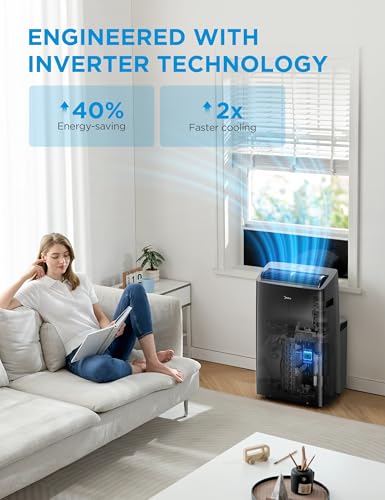
Variable-Speed Inverter Mechanics and Power Consumption
Conventional portable air conditioners rely on single-speed reciprocating compressors that operate in a continuous on-or-off binary cycle. These standard compressors run at 100 percent capacity until reaching the thermostat setpoint, shut down abruptly, and then reignite at maximum load when the room warms up. This cyclical behavior produces massive electrical surges, frequent temperature swings, and excess mechanical wear. In contrast, the Midea Duo integrates an inverter-driven rotary scroll compressor that continuously modulates its operational frequency based on real-time room heat loads, mirroring the engineering precision found in advanced climate systems like the whynter nex inverter portable air conditioner arc-1230wn.
A closer look at the midea smart inverter portable air conditioner specs confirms the operational efficiency gains provided by this variable-speed platform. Powered by a standard 115-volt residential circuit with a peak rating of 1300 watts, the variable-speed compressor cuts energy consumption by more than 40 percent compared to U.S. federal minimum standards. Rather than cycling off entirely once the setpoint is reached, the rotary scroll motor slows down to an ultra-low frequency, drawing minimal wattage to offset incoming ambient heat gain. This smooth modulation eliminates inductive current spikes while maintaining indoor temperatures within a fraction of a degree.
The efficiency of the system is reflected in its Seasonal Energy Efficiency Ratio of 8.9 and an estimated annual energy consumption of 475.97 kWh. For homeowners managing high utility costs during peak summer months, running an inverter unit at partial displacement delivers substantial electricity reductions compared to cycling fixed-displacement machinery. Operating exclusively in cooling mode charged with R 410A refrigerant, the system directs all available electrical power toward latent and sensible heat removal without bleeding current into secondary electric heating strips.

Acoustic Dampening and Low-Decibel Operation
Managing operational noise represents one of the steepest challenges in portable air conditioner design because the compressor, condenser fan, and evaporator blower share the exact same housing inside the living space. Standard portable units routinely generate noise pressure levels between 52 and 58 dB, which can easily overwhelm normal conversation, interfere with home office phone calls, and disrupt light sleepers. The Midea Duo solves this acoustic issue by achieving a low-speed noise rating of 42 dB, establishing an acoustic profile nearly indistinguishable from the background noise floor of a library.
This dampening is directly attributable to the physical properties of its variable-speed rotary scroll compressor. Unlike single-speed reciprocating piston units that produce harsh harmonic vibrations and mechanical clatter during high-pressure strokes, the continuous circular motion of a rotary scroll design generates minimal rotational imbalance. Supported by internal structural dampeners and a low-turbulence air channel, the chassis resists resonant buzzing and prevents motor vibrations from transferring into hard residential flooring.
Airflow acoustics are managed through an aerodynamically optimized blower duct. While running at maximum output to cast air across its full 26-foot projection range, the system generates smooth, laminar air movement that avoids turbulent wind hiss. Once the target temperature is achieved, the fan and compressor simultaneously settle into low-frequency maintenance modes. At 42 dB, the appliance remains unobtrusive when positioned next to beds, work desks, or entertainment centers, cooling the surrounding zone without forcing users to turn up media volume.

Smart Connectivity, Automation, and Physical Installation
Modern residential climate management requires responsive automation tools that match fluid household schedules. The Midea Duo includes a built-in Wi-Fi module engineered for seamless pairing with the Midea SmartHome app on both iOS and Android platforms. Users can monitor room temperatures, adjust setpoints, and construct custom operating schedules from any internet connection. The unit also supports voice command integration through Amazon Alexa and Google Assistant ecosystems, giving users hands-free control over operational modes and power states without touching the physical console or reaching for the included remote.
Physical installation is substantially streamlined by the specialized window assembly. Traditional dual-hose configurations force users to align two separate, stiff duct pipes into a wide window plate, often demanding excessive window width and creating clumsy aesthetic clutter. The Duo uses a single integrated concentric housing that connects into a packaged window slider kit. Featuring a vertical pull-out mechanism, this bracket system minimizes air leakage around the window frame, reduces spatial encroachment into the room, and packs away cleanly for winter storage without misplaced hardware.
System maintenance is handled through a dual-stage filtration assembly containing a washable primary dust filter and an Air Fresh filter insert. This dual-filter configuration traps airborne pet hair, household dust, and large particulates before they can accumulate on the internal evaporator coil, preserving thermal heat-transfer efficiency and maximizing airflow delivery over multiple seasons. Potential buyers should note that this packaged system is engineered strictly for residential cooling and does not incorporate a reverse-cycle heat pump or supplemental electric heating hardware.
Midea Duo 14,000 BTU Pros and Cons
Pros
- Variable-speed inverter compressor cuts energy draw
- Duo hose-in-hose design stops negative room pressure
- Low 42 dB operational noise level
- Long 26-foot airflow projection distance
- SmartHome app and voice assistant integration
Cons
- Cooling-only mode with no integrated heat option
- Substantial 1300-watt maximum power draw
- Utilizes legacy R 410A refrigerant
Is the Midea Duo 14,000 BTU Worth It
Determining whether the Midea Duo represents the right purchase depends on your window geometry, floor layout, and noise sensitivity. For tenants, apartment residents, and homeowners whose building guidelines or window types prohibit permanent mini-splits or window-mounted units, this machine overcomes the traditional thermal penalties of portable cooling. By coupling a variable-speed rotary scroll inverter with a balanced hose-in-hose airflow system, it delivers authentic whole-room climate control while entirely eliminating the destructive negative air pressure common to standard single-hose appliances.
This appliance is an ideal match for primary bedrooms, home offices, and open floor plans up to 550 square feet where quiet performance is non-negotiable. Shoppers prioritizing lower electricity consumption will appreciate the 8.9 SEER rating, the 475.97 kWh annual consumption profile, and the inverter motor’s ability to throttle down instead of drawing repetitive locked-rotor surge currents. The inclusion of the SmartHome app, remote control, and voice assistant compatibility guarantees convenient integration into connected smart home environments.
However, buyers seeking a multi-season climate machine with integrated winter heating must pass on this model, as its operating architecture is limited strictly to cooling. Furthermore, while the concentric hose design is dramatically sleeker than dual independent ducts, the unit still requires floor space near an accessible window and draws up to 1300 watts on a dedicated 115-volt residential circuit. If your space meets these physical layout parameters, the Midea Duo delivers outstanding engineering refinement, high efficiency, and class-leading noise control.
FAQ
What is the difference between the 14,000 BTU rating and the 12,000 BTU SACC rating?
The 14,000 BTU figure denotes nominal ASHRAE capacity, a laboratory metric that measures raw heat extraction without accounting for duct heat radiation or room air infiltration. The 12,000 BTU SACC (Seasonally Adjusted Cooling Capacity) rating is a rigorous federal standard that accounts for real-world environmental losses. Because the Duo hose-in-hose design stops unconditioned outdoor air from leaking into the living space, the unit preserves 12,000 SACC BTUs of usable cooling power, outperforming single-hose alternatives that suffer severe thermal penalties.
How does the concentric Duo hose improve cooling efficiency?
Standard single-hose portable air conditioners push room air outdoors across the hot condenser, creating negative air pressure that sucks hot outdoor air into the room through gaps in doors and window frames. The Midea Duo uses a concentric dual hose-in-hose assembly that pulls outdoor air across the condenser and vents it back outside. This forms a balanced outdoor air loop that keeps indoor atmospheric pressure neutral, preventing hot outdoor air from seeping inside.
How quiet is the Midea Duo during nighttime operation?
The Midea Duo achieves a minimum operational sound level of 42 dB during low-speed cooling, which is comparable to the quiet ambient environment of a public library. This low acoustic floor is achieved by the variable-speed rotary scroll inverter compressor, which minimizes mechanical vibration and avoids the sudden start-stop clatter associated with standard fixed-speed air conditioners.
What are the electrical requirements to run the Midea Duo?
The system operates on a standard residential 115-volt corded electric power supply with a maximum power rating of 1300 watts. Because the variable-speed inverter gradually ramps up compressor speeds instead of drawing sudden electrical spikes, it significantly reduces the likelihood of tripping standard 15-amp household circuit breakers.
Can the Midea Duo provide supplemental heating during winter months?
No. The Midea Duo 14,000 BTU model detailed in the specifications operates exclusively as a residential cooling system. It does not include a reverse-cycle heat pump or an electric resistance heat strip for winter heating.
How do the smart connectivity features function on this air conditioner?
The unit features factory-integrated Wi-Fi that pairs directly with the Midea SmartHome app for iOS and Android devices. Users can adjust target temperatures, establish automated schedules, and switch fan settings remotely. The system also integrates with Amazon Alexa and Google Assistant devices for hands-free voice commands, in addition to the supplied standard handheld remote control.
See the current listing on Amazon
Specifications on this page are read from the product listing. Ratings are the average left by Amazon buyers.


