As Amazon Associates, we earn from qualifying purchases. This means we may receive a small commission at no extra cost to you if you click through and make a purchase.

- Brand
- Levoit
- Buyer rating
- 4.3 out of 5
- Mostly positive, average of Amazon buyer ratings
Selecting an indoor air cleaner requires matching filtration metrics, airflow volume, and physical acoustic output to the exact dimensions of your living space. If you are researching the Levoit Core 300, you are likely evaluating whether a compact, manual air purifier provides enough clean air delivery to handle common household allergens, dust, and smoke in an enclosed bedroom or living area. Rather than relying on unverified claims, this standalone unit carries official testing credentials that establish its real-world performance parameters, giving buyers precise numbers to evaluate before making an investment.
This technical breakdown examines the core engineering characteristics that define the system. We explore verified airflow rates, particulate capture limits, power efficiency across typical electrical grids, and operational sound pressure levels. By comparing documented performance benchmarks against day-to-day requirements, this analysis clarifies where the standard unit excels, how it differs from connected alternatives in the lineup, and whether its specific mechanical layout meets your room filtration standards.
What You Get With the Levoit Core 300
The product packaging delivers a self-contained, mechanical air cleaning system designed for immediate deployment without complex assembly or third-party hardware requirements.
- Levoit Core 300-P cylindrical air purifier unit
- Pre-installed genuine 3-in-1 multi-stage filtration assembly
- Integrated 56-watt high-torque AC motor and radial fan system
- On-chassis capacitive touch control interface
- Selectable countdown timer supporting 2, 4, 6, and 8-hour operating cycles
- Dedicated display shut-off control for fully darkened room operation
- Automated check filter indicator LED
- Standard polarized 120V alternating current power supply cord
Key Specifications
Documented engineering specifications provide an objective baseline for comparing the system against competing air filtration platforms. The table below compiles official performance metrics, physical dimensions, and operational certifications.
| Attribute | Specification Detail |
|---|---|
| Model Number | Core 300-P |
| Smoke CADR | 143 CFM |
| Dust CADR | 153 CFM |
| Pollen CADR | 167 CFM |
| Primary Coverage (4.8 ACH) | 222 sq ft |
| Maximum Coverage (1.0 ACH) | 1,073 sq ft |
| Minimum Noise Output | 24 dB (Sleep Mode) |
| Rated Power Draw | 56 Watts |
| Filtration Efficiency | 99.97% for 0.1 to 0.3 micron particulates |
| Dimensions & Weight | 8.7″D x 8.7″W x 14.2″H; 7.9 lbs |
| Electrical Rating | 120V AC, 60Hz (United States only) |
| Compliance & Certifications | AHAM Verifide, CARB Compliant, ETL Listed, FCC |

Airflow Dynamics and Clean Air Delivery Rates
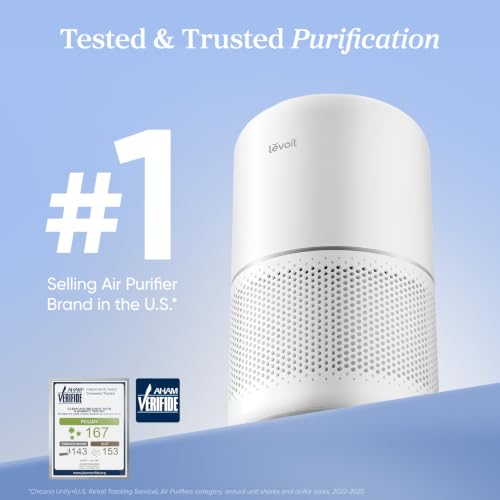
The primary benchmark for any residential air purifier is its Clean Air Delivery Rate, an objective metric independently verified by the Association of Home Appliance Manufacturers. The AHAM certification confirms that the levoit air purifier 300 operates with a levoit core 300 cadr rating of 143 CFM for tobacco smoke, 153 CFM for fine dust, and 167 CFM for airborne pollen. Because CADR measures the volume of clean air delivered per minute in cubic feet, these differential ratings reflect how efficiently the unit separates particles of varying masses and aerodynamic properties from the intake air stream.
Translating these volumetric rates into physical floor plans establishes the practical levoit core 300 room size coverage. According to AHAM testing guidelines, the unit effectively circulates and scrubs the air within a 222-square-foot room approximately 4.8 times per hour, which equates to a full air exchange roughly every 12.5 minutes. In larger environments, air exchange velocity slows down proportionately. The motor and aerodynamic housing can cycle the volume of a 1,073-square-foot space once per hour, making it capable of baseline air movement in open floor plans, though rapid allergen removal is optimized within enclosed rooms under 250 square feet.
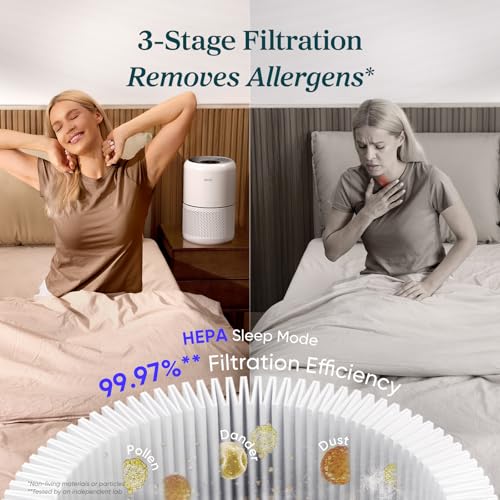
Filtration efficiency depends heavily on the cylindrical 360-degree intake structure, which pulls unfiltered ambient air from all lateral angles before forcing it inward through the filter media. The listing indicates that the internal filter provides 99.97% capture efficiency for microscopic particles between 0.1 and 0.3 microns in size, targeting cigarette smoke, wildfire soot, dust, pollen, volatile organic compounds, and pet dander. Independent laboratory testing per standard IEST RP C001.7 confirms the Levoit Original Filter performs at a true HEPA grade during Sleep Mode operation, ensuring particle retention remains uncompromised even at lowest mechanical velocity.
Acoustic Profile and Bedroom Suitability
Operating an air cleaner in resting environments requires strict management of motor vibration and aerodynamic turbulence. Deploying the levoit core 300 for bedroom environments is supported by the unit’s specialized acoustic engineering, known as QuietKEAP Technology. This internal dampening design minimizes mechanical motor hum and limits fan blade flutter, achieving a documented levoit core 300 noise level db rating of exactly 24 dB when configured in Sleep Mode.
A sound pressure level of 24 dB sits well below the ambient background noise found in typical residential nighttime environments, which generally measures between 30 and 35 dB. At this threshold, the air purifier operates at a near-inaudible hum, generating gentle, non-disruptive white noise rather than irregular mechanical whine. For sleepers sensitive to light pollution, the top capacitive console includes a display-off command that completely deactivates all onboard LEDs while maintaining uninterrupted airflow throughout the night.
When the unit shifts out of Sleep Mode into higher manual fan velocities, noise levels scale upward in direct proportion to the 56W motor’s rotational speed. While daytime high-speed settings are audible across an enclosed space, they provide the necessary aerodynamic velocity to rapidly exhaust airborne contaminants following cooking events or high-pollen exposure. For users who need dedicated bedside filtration without high-output daytime cycling, ultra-compact solutions like the levoit core mini air purifier offer smaller footprints, though they lack the high-volume air exchange volume verified in the Core 300 platform.
Power Consumption and Long-Term Maintenance
Continuous room purification demands an understanding of sustained electrical loads. The core 300 power consumption watts specification is listed at 56 watts at maximum operational capacity under standard 120V alternating current. Because the unit utilizes a high-torque AC motor engineered specifically for the North American domestic power grid, it must be operated exclusively on 120V systems, precluding direct connection to 220V or 240V international circuits without specialized step-down transformers.
Because the unit uses a manual control scheme rather than automated sensor adjustments, the electrical load remains constant at whichever speed profile you manually select. Running the purifier continuously at its maximum 56-watt ceiling draws roughly 1.34 kilowatt-hours per 24-hour cycle. Operating in Sleep Mode significantly drops motor draw, reducing ongoing electrical consumption while maintaining continuous mechanical circulation. The built-in count-down timer allows automated shutoff intervals of 2, 4, 6, or 8 hours to eliminate unnecessary power draw when rooms remain unoccupied.
Beyond electrical inputs, mechanical upkeep centers around the 3-in-1 multi-stage filtration core. The official manufacturer guidance establishes a levoit core 300 filter replacement interval of 6 to 8 months under standard operating conditions. High-particulate loads from indoor pets, wood smoke, or persistent dust will accelerate media loading and necessitate earlier replacement. An onboard check filter indicator light monitors cumulative run time and illuminates to notify the user when airflow resistance requires a fresh cartridge. Installing genuine original replacement filters ensures that the certified CADR volume and 0.1 to 0.3 micron capture ratings remain fully compliant with published specifications.

Manual Architecture Versus Smart Model Differences
A critical consideration for buyers comparing models within this product family is the operational distinction between the levoit core 300 vs 300s. The unit analyzed here is the Core 300-P, a purely mechanical, manually configured appliance. The manufacturer data explicitly specifies that the Core 300-P and Core P350-P variants do not include Auto Mode and do not feature integrated particulate laser sensors. Consequently, the user must manually select between the available fan speeds based on personal observation of room air conditions.
In contrast, the smart-enabled Core 300S-P integrates internal optical air quality detection, an automated operational mode that throttles motor speed based on live particle counts, and Wi-Fi connectivity for remote smartphone and voice control. The manual Core 300-P omits all networking hardware, wireless radios, and onboard firmware updates. This structural difference makes the manual Core 300-P impervious to smart-home connection dropouts, Wi-Fi configuration headaches, or software obsolescence, functioning as an entirely offline, button-controlled air filtration appliance.
For shoppers weighing whether to step up in hardware capacity, comparing the Core 300 to larger platforms such as the levoit core 400s-p smart air purifier highlights trade-offs in room sizing and automation. While the 400S provides substantially expanded volumetric throughput and native smart controls for expansive open layouts, the standard manual Core 300 remains focused on isolated, room-specific duty where simplicity and predictable manual controls are preferred over automated networking features.
Levoit Core 300 Pros and Cons
Pros
- AHAM Verifide CADR performance
- Quiet 24 dB Sleep Mode
- 97% capture at 0.1 microns
- Full display light shut-off control
- Multi-stage 3-in-1 cylindrical filter
- Independent CARB and ETL certifications
Cons
- No integrated Auto Mode
- Lacks smart app connectivity
- Restricted to 120V power grids
Is the Levoit Core 300 Worth It
Determining whether the levoit core 300-p air purifier aligns with your household needs comes down to your room size, tolerance for manual adjustments, and desire for verified mechanical efficiency. For individuals seeking dependable, laboratory-tested air cleaning in bedrooms, home offices, and nursery spaces up to 222 square feet, the system represents an exceptionally well-engineered tool. The combination of an AHAM-verified 143 CFM smoke CADR, a whisper-quiet 24 dB sleep setting, and complete display illumination shutoff makes it tailored for undisturbed nighttime use.
Conversely, shoppers searching for a fully automated, “set-and-forget” air treatment system may find the manual interface limiting. Because the Core 300-P lacks onboard air quality sensors, it cannot automatically spin up its 56W motor when airborne dust spikes or cooking odors migrate into the living area. If your primary objective is monitoring live particulate levels on a smartphone display or maintaining automated fan speeds across a large open living room exceeding 500 square feet, an automated, higher-capacity smart platform will prove more functional.
For those prioritizing verified filtration performance, rugged physical build quality, and straightforward manual operation without wireless setup, the Core 300 delivers robust engineering. With certified compliance across AHAM, CARB, and ETL standards, it cleans room air predictably, retains ultra-fine particulates down to 0.1 microns, and operates without unwanted noise, confirming that the unit remains a benchmark for compact manual air purification.
FAQ
What is the CADR rating of the Levoit Core 300?
The unit features an AHAM Verifide Clean Air Delivery Rate of 143 CFM for smoke, 153 CFM for dust, and 167 CFM for pollen particulates.
What room size does the Core 300 clean effectively?
The system is rated to refresh the air in a 222-square-foot room 4.8 times per hour. In larger spaces up to 1,073 square feet, it provides one complete air exchange per hour.
Does the Levoit Core 300 have an automatic fan mode?
No. The Core 300-P is a manual air purifier that requires the user to select fan speeds by hand. Automatic speed adjustment and smart app connectivity are exclusive to the Core 300S-P model.
How loud is the air purifier during night operation?
When configured in Sleep Mode using QuietKEAP Technology, the Core 300 operates at an ultra-low noise level of 24 dB, and the console display lights can be completely deactivated.
How often do the filters need to be replaced?
The manufacturer recommends replacing the 3-in-1 multi-stage filter every 6 to 8 months, using official genuine Levoit replacement filters to preserve rated CADR performance and filtration efficiency.
Can this air purifier be used outside the United States?
The unit is designed with an AC power supply rated strictly for 120V operation, making it suitable for use only in the United States or on compatible 120V electrical systems.
See the current listing on Amazon
Specifications on this page are read from the product listing. Ratings are the average left by Amazon buyers.


