As Amazon Associates, we earn from qualifying purchases. This means we may receive a small commission at no extra cost to you if you click through and make a purchase.

- Brand
- Wildgameplus
- Our score
- 8.4 out of 10
- Mostly positive
Deploying a self-sustaining radio repeater in remote terrain requires careful scrutiny of charging efficiency, battery capacity, and quiescent current draw. The KEEPTEEN D5L Heltec V4 packages these components into an integrated unit designed to serve as an autonomous off grid lora solar node. By pairing a 5W monocrystalline silicon photovoltaic surface with an internal charging circuit, dual 18650 lithium-polymer cells, and Heltec’s updated ESP32-S3 and SX1262 platform, this unit eliminates the trial-and-error of assembling custom weatherized enclosures, soldering battery protection boards, and wiring discrete step-down converters for field deployments.
Whether this all-in-one setup provides sufficient energy generation during consecutive overcast days depends directly on your transmission intervals, radio sleep cycles, and regional solar irradiance. This comprehensive keepteen d5l-h3 review analyzes the verified heltec v4 solar panel specs, hardware architecture, thermal design, and power budget calculations. The following sections examine the hardware bundled inside the kit, evaluate electrical performance metrics, dissect real-world range capabilities, and assess whether this wildgameplus d5l lora kit meets the operational requirements of an unattended radio relay station.
What You Get With the KEEPTEEN D5L Heltec V4
The kit arrives as a comprehensive hardware bundle designed to minimize third-party sourcing, containing both the structural outdoor housing and the core compute hardware needed to establish an operational link right out of the box.
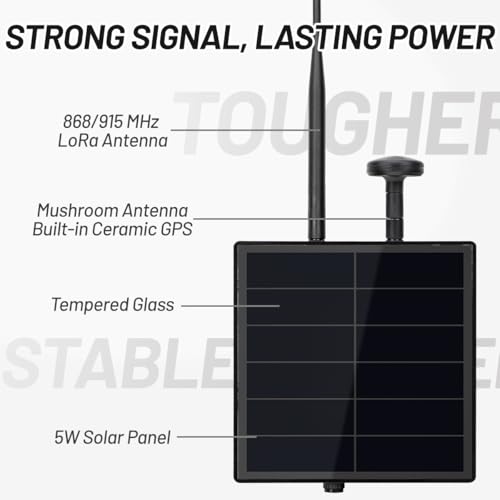
- One 5W monocrystalline silicon solar panel housed inside an aluminum chassis with a tempered glass protective face
- One Heltec ESP32 LoRa V4 development board equipped with an ESP32-S3 microprocessor and an SX1262 LoRa transceiver
- Two rechargeable 18650 LiPo batteries delivering a combined nominal capacity of 5200mAh
- One tuned 915MHz omnidirectional LoRa whip antenna for sub-GHz communications
- One external GPS mushroom antenna designed for satellite position tracking
- One articulating mounting bracket with accompanying installation hardware for mast or wall attachment
- One printed product manual detailing operational guidelines and connection pinouts
Key Specifications
A rigorous evaluation of any off-grid hardware platform begins with raw technical parameters. The table below outlines the core hardware specifications provided by the manufacturer for the D5L-H3 platform.
| Hardware Attribute | Manufacturer Specification |
|---|---|
| Brand Name | WILDGAMEPLUS / KEEPTEEN |
| Model Designation | D5L-H3 |
| Solar Collector Peak Output | 5 Watts |
| Photovoltaic Cell Material | Monocrystalline Silicon with Glass Face |
| Chassis Material | Aluminum and Glass |
| Physical Dimensions | 8.6 inches Long x 5.4 inches Wide x 1.0 inch High |
| Processing Microprocessor | Espressif ESP32-S3 |
| LoRa RF Transceiver | Semtech SX1262 (915MHz configuration) |
| Wireless Interfaces | LoRa, 2.4GHz Wi-Fi, Bluetooth Low Energy (BLE) |
| Energy Storage System | Dual 18650 Lithium-Polymer Cells (5200mAh Total) |
| Claimed Coverage Radius | 1 to 3 km Urban, 3 to 10 km Rural (line-of-sight dependent) |
| Manufacturer Warranty | 1 Year |
Solar Generation and Power Budget Metrics
Operating an unattended field node successfully requires balancing daily milliwatt-hour generation against baseline component consumption. The 5W monocrystalline solar panel integrated into this enclosure measures 8.6 inches by 5.4 inches, presenting a compact collection area suited for mounting to poles or structural fascia. Under optimal conditions with direct solar exposure, a 5-watt panel yields approximately 15 to 20 watt-hours of energy per day assuming three to four peak sun hours. This level of generation provides ample headroom to recharge the dual 18650 battery bank while simultaneously powering the micro-controller, provided the system firmware enforces disciplined low-power sleep states.
The integrated energy reservoir consists of two parallel 18650 cells providing a combined 5200mAh rating at a nominal 3.7 volts, representing roughly 19.24 watt-hours of gross energy storage. When configuring a 5w solar panel 5200mah lora repeater, this battery capacity acts as an essential buffer during prolonged stretches of rain or cloud cover. If your active node maintains an average continuous draw of 25mA through aggressive sleep duty-cycling, the 5200mAh bank theoretically provides over 200 hours of continuous runtime without any solar input. However, if peripheral modules such as the GPS receiver or unmanaged Wi-Fi radios remain permanently active, continuous current draw can surge past 120mA, draining the internal cells in under 48 hours without direct sunlight.
Unlike massive transportable power stations such as the bluetti solar generator ac70, which can absorb continuous multi-amp loads, micro-scale solar nodes rely on strict power conservation. The internal charge circuit in the D5L-H3 manages power delivery between the solar face and the lithium cells, but because the listing does not specify maximum power point tracking (MPPT) circuitry, operators should anticipate standard pulse-width or linear charging efficiencies. During sub-optimal winter months where peak sun hours drop below two hours daily, aligning the panel perpendicular to the solar arc is mandatory to ensure energy input exceeds daily system depletion.

ESP32-S3 and SX1262 Hardware Architecture
The operational core of this node is built around the Heltec ESP32 LoRa V4 development board, which represents a significant architectural evolution over earlier microcontrollers. The board incorporates an Espressif ESP32-S3 dual-core processor alongside a Semtech SX1262 sub-GHz radio transceiver. This pairing establishes an exceptionally versatile esp32-s3 sx1262 solar node capable of executing complex mesh protocols, routing algorithms, and localized cryptographic encryption without bogging down the radio execution thread. The ESP32-S3 chip brings native USB-CDC support, hardware vector instructions, and dedicated low-power coprocessor modes that allow the main CPU cores to shut down while monitoring GPIO interrupts or timer thresholds.
Managing the heltec esp32 v4 power consumption requires an understanding of the SX1262 transceiver’s operational modes. Compared to legacy SX1276/SX1278 radios, the SX1262 chip improves receive current consumption significantly, pulling roughly 4.2mA to 8mA during packet listening states depending on whether internal DC-DC conversion is active. During high-power transmissions up to +22 dBm, current draw spikes to approximately 100mA to 120mA for the duration of the packet broadcast. Because LoRa packets transmit in brief bursts spanning several hundred milliseconds, keeping the duty cycle low ensures that average operational power remains measured in single-digit milliamperes.
For network operators considering the Heltec V4 for meshtastic repeater deployments, the inclusion of Bluetooth Low Energy is a pivotal administrative feature. The listing highlights Bluetooth phone tethering, which allows operators to update device settings, modify radio parameters, and view diagnostic telemetry directly from an iOS or Android device in the field. This capability eliminates the need to carry laptops or disassemble the physical housing to access internal serial ports once the node is mounted at elevation. Wi-Fi capabilities are also natively present on the ESP32-S3 silicon, though utilizing active Wi-Fi for telemetry forwarding significantly accelerates battery drain and should generally be disabled on solar-dependent nodes.

RF Performance and Antenna Configuration
Wireless propagation performance on sub-GHz frequencies is overwhelmingly dictated by antenna efficiency, elevation, and terrain obstruction. The KEEPTEEN package supplies a dedicated 915MHz whip antenna along with an external GPS mushroom antenna. The 915MHz band operates within the standard North American unlicensed ISM allocation, making it well-suited for distributed community meshes, agricultural sensor telemetry, and civilian emergency communication relays. The included GPS mushroom antenna mounts externally to acquire precise coordinates and satellite time locks, which are crucial for nodes running time-synchronized network hops or location beacons.
Manufacturer claims for the D5L-H3 cite an operational range of 1 to 3 kilometers in dense urban environments and 3 to 10 kilometers in open rural areas. While these figures represent reasonable expectations under clear line-of-sight conditions, real-world RF propagation depends strictly on elevation above the surrounding canopy and clearance of the first Fresnel zone. Deploying the node on an unobstructed rooftop or high ridgeline allows the SX1262 radio and 915MHz antenna to easily achieve multi-kilometer links using standard spreading factors. Conversely, ground-level installations surrounded by reinforced concrete or dense pine forests will experience significant attenuation, compressing reliable packet reception down to the lower end of the rated scale.
Much like selecting high-performance outdoor imaging stations such as the reolink argus pt ultra, positioning radio hardware requires an unobstructed vantage point. The external connectors on the D5L-H3 chassis permit antenna mounting directly to the housing, though operators seeking maximum range may choose to couple the radio to high-gain external collinear antennas using low-loss coaxial cabling. It is worth noting that the listing does not specify the precise decibel gain (dBi) rating of the included stock 915MHz whip antenna, meaning users aiming for ultra-long-distance links will likely benchmark the factory antenna before deciding whether an aftermarket upgrade is warranted.

Environmental Build and Thermal Considerations
Field-deployed infrastructure must endure direct solar radiation, torrential rain, and extreme temperature fluctuations without allowing moisture ingress to corrode internal circuits. The D5L-H3 chassis integrates the 5W solar collector directly into the front structural face of the enclosure, utilizing an aluminum perimeter frame combined with a tempered glass protective plate. Measuring 8.6 by 5.4 by 1.0 inches, the resulting assembly forms a rigid, monolithic rectangular profile that presents low wind resistance when bolted to a vertical pipe or structure using the included articulating mount.
While the combination of aluminum and tempered glass provides superior resistance against UV degradation compared to common 3D-printed plastics, long-term environmental durability also hinges on the enclosure’s moisture sealing. The listing states the kit is intended for off-grid installations, remote campsites, and hiking expeditions, but the listing does not specify a formal Ingress Protection (IP) rating such as IP65 or IP67. As a result, users installing the unit in areas exposed to driving wind and rain should inspect all cable glands, gasket lines, and antenna thread interfaces, reinforcing external seams with self-amalgamating silicone tape as a standard precaution.
Thermal management is an equally critical operational consideration when housing lithium-polymer chemistry in direct contact with solar collectors. Dark monocrystalline panels can reach temperatures exceeding 60 degrees Celsius under midday summer sun, transferring heat directly into the rear enclosure space. While the aluminum chassis acts as an effective heat spreader for the ESP32-S3 microcontroller, lithium cells degrade faster when subjected to continuous elevated temperatures. Similarly, standard 18650 lithium chemistries cannot be safely charged when ambient temperatures drop below freezing (0 degrees Celsius). Consequently, operators placing these nodes in harsh northern winter environments must verify whether their software stack supports thermal charge-cutoff protection.
KEEPTEEN D5L Heltec V4 Pros and Cons
Pros
- Integrated 5W monocrystalline solar panel with aluminum chassis
- Dual 18650 LiPo battery setup yielding 5200mAh capacity
- ESP32-S3 and SX1262 chipset supports advanced protocols
- Includes dedicated 915MHz LoRa and GPS mushroom antennas
- Bluetooth connectivity enables wireless mobile configuration
Cons
- The listing does not specify a formal IP waterproof rating
- Integrated panel design prevents angling solar face independently
- Dual 18650 capacity limits runtime under extended winter freezes
Is the KEEPTEEN D5L Heltec V4 Worth It
Deciding whether this integrated kit fits your specific networking needs comes down to your technical priorities and tolerance for DIY assembly. For network operators, search-and-rescue teams, and rural landowners seeking a self-contained radio repeater that can be mounted and configured within twenty minutes, the hardware provides an outstanding out-of-the-box foundation. Buying a separate 5W solar panel, designing a weatherized housing, purchasing an authentic Heltec ESP32 V4 development board, and sourcing dual 18650 cells with appropriate connectors often results in higher overall complexity and component costs. The ability to manage node configuration over Bluetooth directly from a smartphone eliminates substantial friction during deployment.
Conversely, users requiring specialized industrial setups or extreme cold-weather endurance may find the hardware bundle restrictive. Because the solar panel is physically integrated into the front face of the electronics housing, you cannot angle the photovoltaic collector toward the sun while pointing your LoRa antenna in a completely independent direction without adjusting the entire unit as a single assembly. Furthermore, advanced builders who require oversized lithium-iron-phosphate (LiFePO4) battery chemistries for continuous sub-zero winter charging will find the fixed dual-18650 LiPo battery sled limiting. For similar autonomous solar monitoring setups, devices like the reolink argus 4 pro solar showcase how specialized solar products solve targeted off-grid power challenges.
Ultimately, if your objective is to rapidly expand a regional mesh network, deploy a solar-powered telemetry relay on an outbuilding, or establish an off-grid tracking station without spending days fabricating enclosures and wiring discrete components, the package represents an exceptionally streamlined hardware solution. Provided you verify antenna sealing and manage radio transmission duty cycles responsibly, the platform provides dependable, autonomous operation across wide geographic spans.
FAQ
Does the KEEPTEEN D5L Heltec V4 come pre-installed with Meshtastic firmware?
The listing does not specify whether open-source Meshtastic firmware comes pre-flashed onto the internal board. The manufacturer highlights that the D5L-H3 functions as a LoRa node and relay station with Bluetooth tethering for settings configuration, but operators planning to integrate the device into a Meshtastic network should be prepared to flash the ESP32-S3 board with the appropriate firmware release via its USB interface if required.
Can the internal 5200mAh battery keep the node running through consecutive rainy days?
Yes, provided the firmware is configured with disciplined power-saving settings. A well-optimized LoRa node drawing an average of 15mA to 25mA consumes roughly 0.36 to 0.60 watt-hours per day. With a 5200mAh (approximately 19.24 watt-hour) dual-cell capacity, the system possesses sufficient reserve storage to endure five to seven consecutive days of heavily overcast weather without suffering a brownout.
Can the 5W solar panel be detached and positioned separately from the electronics housing?
No. The 5W monocrystalline solar panel is physically integrated into the structural front face of the aluminum enclosure. To position the panel toward the sun, the entire enclosure must be oriented accordingly using the included articulating mount, which also determines the initial physical angle of the attached antennas.
What frequencies does the integrated LoRa radio support?
The unit features the Heltec ESP32 V4 board paired with a 915MHz tuned LoRa whip antenna, making it natively configured for the 902-928MHz ISM frequency band commonly used in North America, Australia, and parts of South America. If you intend to operate the node in regions utilizing 868MHz or 433MHz, you must ensure hardware component compatibility before transmitting.
Is an external power supply required to set up the device initially?
No external power supply is mandatory if the included dual 18650 cells retain factory storage charge or have been placed under sunlight to charge via the 5W panel. Initial configuration can be performed wirelessly via Bluetooth tethering to a mobile phone, though the internal board can also receive power through its standard micro-controller USB interface during bench testing and firmware flashing.
See the current listing on Amazon
Specifications on this page are read from the product listing. Scores are out of 10, based on listed specifications and buyer feedback.