As Amazon Associates, we earn from qualifying purchases. This means we may receive a small commission at no extra cost to you if you click through and make a purchase.

- Brand
- Flashforge
- Buyer rating
- 4.2 out of 5
- Mostly positive, average of Amazon buyer ratings
Shoppers evaluating the Flashforge AD5X generally want to confirm whether its multi-filament hardware, high-velocity kinematics, and elevated thermal thresholds satisfy exacting prototyping demands. As a desktop multi-material platform, this machine addresses persistent engineering bottlenecks associated with manual filament swaps, purge waste, and mechanical resonance at high acceleration rates. The integrated setup directly targets fabricators, product designers, and technical hobbyists who demand tight dimensional accuracy alongside vibrant, multi-tone output without spending hours calibrating aftermarket feeder modules. Readers can expect a compact desktop platform engineered around high-speed motion routines, capable of handling everything from flexible elastomers to structural composites, provided the operational limits of its open-frame architecture are clearly understood.
Determining whether this hardware configuration fits into your production setup requires a thorough examination of how its subsystem mechanics compare with predecessor platforms like the flash forge 5m and current desktop fabrication benchmarks. This technical analysis explores the real-world mechanical viability of the Flashforge AD5X, covering its 4-color direct IFS mechanism, CoreXY structural kinematics, 300°C hotend thermal envelope, first-layer automated leveling behaviors, and overall material compatibility. By breaking down the raw physical specifications alongside practical operational constraints, this guide provides an exhaustive roadmap to assist your purchasing decision.
What You Get With the Flashforge AD5X
The factory configuration of this platform combines high-throughput kinematic hardware with an integrated multi-material delivery assembly, presenting an out-of-the-box solution for complex multi-tonal geometry. Below are the core features, integrated hardware systems, and technical components documented in the manufacturer specifications:
- 600mm/s maximum printing speed driven by a rigid CoreXY frame, precision linear rails, and active vibration compensation algorithms designed to preserve 0.1mm layer resolution.
- Integrated 4-color direct printing powered by the automated IFS system, supporting sequential and gradient filament transitions across standard and specialized materials.
- 300°C all-metal hotend assembly engineered for high-temperature extrusion, featuring a 30-second rapid-swap nozzle interface for expedited maintenance and diameter changes.
- Automated bed leveling system paired with a removable magnetic PEI spring steel build plate to ensure repeatable first-layer adhesion and effortless part extraction.
- Integrated filament runout sensor that automatically halts print execution when spool depletion occurs, mitigating failed runs and filament waste.
- Dual-band Wi-Fi networking supporting both 2.4GHz and 5GHz operational bands, paired with remote monitoring tools via the native Flashforge mobile application.
- HD camera ready hardware interface that accommodates video integration for remote real-time monitoring and automated timelapse rendering.
- Robust all-metal chassis design maintaining an operational footprint of 14.8 by 14.3 by 16.3 inches with a total system weight of 14.2 kg.
Key Specifications
| Technical Parameter | Hardware Specification |
|---|---|
| Product Name | Flashforge AD5X |
| Manufacturer & Brand | FLASHFORGE |
| Kinematic Architecture | CoreXY with Precision Linear Rails |
| Maximum Print Velocity | Up to 600 mm/s |
| Maximum Nozzle Temperature | 300°C All-Metal Hotend (30-second quick swap) |
| Build Envelope | 220 x 220 x 220 mm |
| Build Surface Material | Magnetic Flexible PEI Spring Steel Plate |
| Multi-Filament Support | 4-Color Direct Printing via IFS System |
| Filament Detection | Integrated Filament Runout Sensor with Auto-Pause |
| Connectivity & Monitoring | Dual-Band Wi-Fi (2.4G/5G), Flashforge App, HD Camera Ready |
| Chassis Dimensions & Weight | 14.8″D x 14.3″W x 16.3″H; 14.2 kg (Metal Construction) |

CoreXY Kinematics and High-Speed Velocity Limits
Analyzing the flashforge ad5x print speed requires dissecting the mechanical physics governing CoreXY motion. Unlike conventional Cartesian bedslingers where the heavy print bed moves back and forth along the Y-axis, a CoreXY system fixes both stepper motors to the stationary frame. Two continuous timing belts coordinate to translate the lightweight toolhead across the horizontal plane. By eliminating the mass of the stepper motors from the moving carriage, the gantry sheds significant inertia. The inclusion of precision linear rails ensures that the toolhead traverses these axes with minimal mechanical deflection, even when subjected to intense acceleration forces.
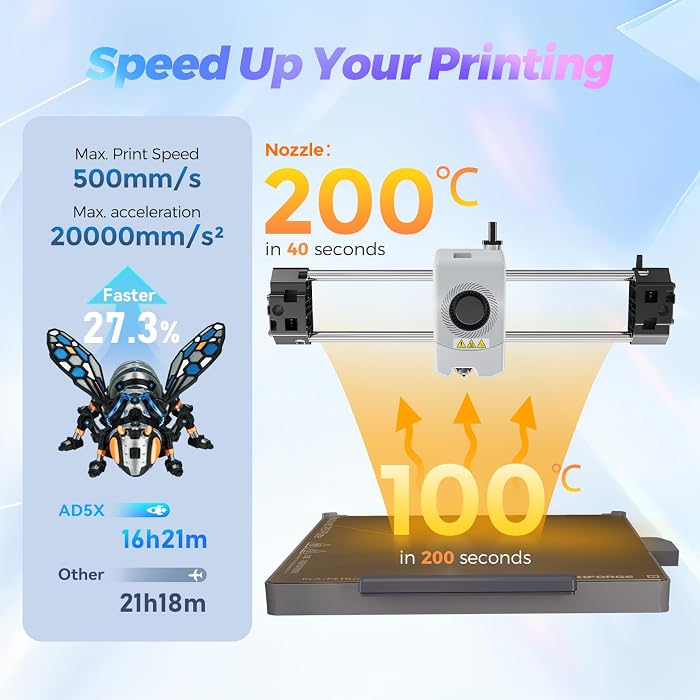
To sustain print quality at high travel velocities, the ad5x corexy performance leverages active vibration compensation. As printing speeds approach 600 mm/s, directional shifts generate mechanical resonance frequencies that cause surface ringing and ghosting artifacts. The onboard vibration compensation algorithms calculate these resonant harmonics and introduce inverted phase adjustments into the motor stepping signals. This stabilization enables the machine to preserve sharp corner geometry and achieve layer resolutions down to 0.1mm, cutting standard project fabrication times by up to 70 percent. Examining how these kinematics perform relative to large-format setups like the k2 pro 3d printer highlights how critical frame rigidity is when maintaining structural precision under high velocity.
Real-world throughput, however, involves more than maximum travel numbers. While the mechanical motion system handles rapid linear vectors effortlessly, sustained extrusion speed is bounded by hotend volumetric flow rates and polymer melt kinetics. Long linear perimeters and expansive infill grids allow the carriage to ramp up to its top velocity, whereas intricate geometries with frequent direction changes remain bound by acceleration and jerk profiles. The 14.2 kg all-metal frame provides the requisite structural mass to anchor the printer, isolating vibrations from the mounting bench and preventing mechanical drift over extended production cycles.
Multi-Material Mechanics of the Four-Color IFS System
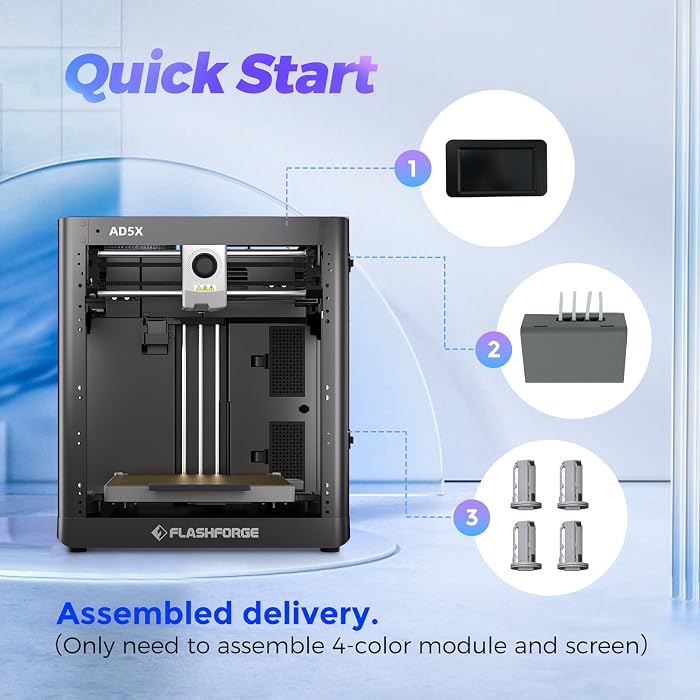
Deploying the flashforge ad5x for multicolor printing shifts the operational workflow by replacing manual spool changes with the automated flashforge ad5x ifs system. This architecture enables 4-color direct printing by cycling four filament feeds directly into the extrusion path without requiring separate external Bowden feeder boxes. The integrated switching mechanism manages filament retraction, toolhead cutting, and subsequent strand insertion automatically. For makers creating multi-colored visual models, pedagogical aids, or functional assemblies with distinct material accents, this direct setup eliminates the need for manual layer-pause interventions.
A critical metric for multi-material hardware is broad material compatibility. The manufacturer documentation specifies that the IFS system auto-swaps PLA, PETG, TPU, and metal-fill filaments. Handling elastomeric materials like flexible TPU alongside rigid metal-filled composites within an automated multi-feed channel requires precise feeding mechanics. TPU strands tend to buckle under compression within traditional long Bowden tubes, while abrasive metal-infused filaments present higher frictional resistance. By positioning the direct feed mechanism close to the hotend, the IFS reduces the length of unsupported filament, minimizing feeding jams across distinct material hardness ratings.
Operational considerations for multi-filament fabrication inevitably involve purge waste and cycle overhead. Every color or polymer swap necessitates purging residual material from the melt chamber to prevent pigment cross-contamination or structural incompatibility between consecutive layers. Transitioning from a dark pigmented filament or an abrasive metal-fill compound to a translucent PLA requires adequate purge volume in the transition tower. While the automated IFS mechanism handles the physical swap cleanly, operators must balance their slicer purge calibration to optimize filament consumption without compromising layer-to-layer color purity.
Thermal Delivery and High-Temperature Hotend Constraints
The thermal capabilities of the flashforge ad5x 300c nozzle expand the machine beyond entry-level hobby polymers. Standard 3D printers often utilize PTFE-lined hotends that release hazardous degradation products and experience thermal breakdown at temperatures exceeding 240°C. In contrast, the all-metal hotend on this printer maintains operational stability up to 300°C. The sharp thermal gradient between the active melt zone and the heatsink prevents heat creep, ensuring consistent melt viscosity during long print jobs. Maintenance and nozzle servicing are streamlined by the 30-second rapid-swap nozzle design, allowing users to swap worn orifices or change nozzle sizes without disassembling the entire heater block assembly.
Despite the high-temperature hotend, the operational envelope for advanced technical polymers requires careful consideration of the build environment. The flashforge ad5x filament compatibility technically includes ABS, Nylon, and Carbon Fiber, but the manufacturer explicitly specifies that processing these materials requires an enclosed chamber kit. Because the standard chassis has an open architecture, ambient air drafts introduce thermal shocks across the build volume. High-shrinkage engineering filaments like Nylon and ABS experience differential thermal contraction, which manifests as severe warping, corner lifting, and interlaminar separation unless printed within a stable, heat-retaining enclosure.
For fabricators dedicated primarily to industrial composite parts that require dedicated environmental thermal management, fully enclosed systems like the flashforge creator 5 demonstrate the necessity of continuous heat retention. On this printer, attempting to run ABS or Carbon Fiber filaments without acquiring the supplemental enclosed chamber kit will yield inconsistent structural properties. Conversely, open-air printing remains entirely reliable for PLA, PETG, TPU, and metal-fill filaments, as these formulations exhibit minimal shrinkage and do not require an insulated chamber to maintain layer adhesion.

First-Layer Adhesion and Bed Calibration Dynamics
Achieving dependable print outcomes depends heavily on the performance of the flashforge ad5x pei build plate and the integrated automated leveling matrix. The automated bed leveling routine measures the surface profile across the heated bed before the print cycle begins. By dynamically adjusting the Z-axis lead screws during toolhead transit, the system compensates for micro-deviations across the 220 x 220 mm build plate. This automated routine eliminates the need for manual bed leveling screws or manual gauge calibration, establishing an even first-layer squish across the entire platform.
The build surface itself is constructed from a flexible spring steel sheet coated with a textured PEI layer. PEI provides exceptional molecular adhesion when heated, locking down polymers like PLA and PETG to prevent premature part detachment during aggressive acceleration sequences. Once the print cycle completes and the platform returns to room temperature, the difference in thermal contraction breaks the interfacial bond. Users can easily remove the magnetically attached spring steel sheet and gently flex it to pop finished models off the plate without needing sharp spatulas that risk gouging the surface.
Complementing the bed leveling system is an integrated optical filament runout sensor located in the filament supply track. If a spool runs dry or snaps mid-print, the sensor immediately signals the mainboard to pause execution and park the toolhead. This automated failsafe prevents the printer from executing dry passes that ruin long prints and waste material. Once a new spool is loaded, the machine resumes the print sequence precisely where it left off, protecting multi-hour fabrication jobs from unexpected spool depletion.
Flashforge AD5X Pros and Cons
Pros
- CoreXY mechanics enabling 600mm/s maximum print speed
- Automated 4-color direct printing with IFS system
- 300°C all-metal hotend with 30-second swap nozzle
- Magnetic PEI spring steel plate with auto-leveling
- Dual-band Wi-Fi connectivity and remote app support
Cons
- Printing ABS and Nylon requires optional enclosure kit
- Build volume limited to 220x220x220mm envelope
- Listing specifies camera ready rather than included camera
Is the Flashforge AD5X Worth It
Determining whether the machine justifies its place in your workflow requires weighing its automated features against its physical working envelope. For hobbyists, digital modelers, and functional prototype designers who require automated multi-color switching out of the box, the system delivers remarkable value. The integrated 4-color direct IFS mechanism removes the calibration hurdles that historically plagued external multi-material systems, while the CoreXY motion platform and 600 mm/s capability provide substantial time savings on rapid concept iterations.
Prospective buyers must also account for specific mechanical trade-offs. The 220 x 220 x 220 mm build envelope is sufficient for desktop components, miniature models, and moderate prototypes, but it restricts users who need to print large, single-piece mechanical enclosures. Additionally, while the 300°C all-metal hotend possesses the thermal headroom for engineering plastics, the base unit is an open-frame printer; buyers intending to fabricate ABS, Nylon, or Carbon Fiber components must factor in the necessity of the optional enclosed chamber kit. Evaluating the comprehensive flashforge ad5x specs ensures that your primary filament choices align with the hardware provided in the standard box.
Ultimately, the Flashforge AD5X is an exceptional option for creators seeking an agile, multi-color fabrication tool with low setup friction and modern networking amenities. The combination of dual-band Wi-Fi, app-based monitoring, a quick-change nozzle interface, and automated bed leveling creates an accessible, highly capable production tool. If your projects center around PLA, PETG, TPU, and metal-fill filaments within a mid-sized footprint, the hardware package offers a robust, highly capable desktop solution.
FAQ
What materials can the Flashforge AD5X print out of the box?
Out of the box, the printer is equipped to print PLA, PETG, TPU, and metal-fill filaments using its direct extrusion toolhead and automated IFS system. Although the all-metal hotend reaches temperatures up to 300°C, high-shrinkage engineering materials such as ABS, Nylon, and Carbon Fiber require the installation of an optional enclosed chamber kit to prevent warping and layer delamination.
How does the IFS system handle multicolor filament changes?
The integrated IFS system facilitates 4-color direct printing by mechanically managing filament retraction, cutting, feeding, and purging within the toolhead assembly. It automatically transitions between four loaded spools during the print process, allowing automated multi-tonal, gradient, and multi-material layering without requiring manual operator intervention during the print job.
Does the Flashforge AD5X come fully enclosed for high-temperature filaments?
The standard model features an open-frame metal chassis structure without fully enclosed side panels or a top lid. The manufacturer specifications explicitly state that printing high-temperature, draft-sensitive materials like ABS, Nylon, and Carbon Fiber requires an enclosed chamber kit, which must be added to the base machine.
Is an HD monitoring camera included with the printer?
The manufacturer listing states that the printer is HD Camera Ready for real-time video streaming and shareable timelapses, but the listing does not specify whether the physical camera module is pre-installed in the box or provided as an optional accessory that must be purchased separately.
What are the build volume dimensions of the Flashforge AD5X?
The printer provides a physical build envelope of 220 x 220 x 220 mm (approximately 8.66 x 8.66 x 8.66 inches). This cubic build volume accommodates standard rapid prototypes, multi-part mechanical assemblies, and medium-scale multicolor artistic models.
See the current listing on Amazon
Specifications on this page are read from the product listing. Ratings are the average left by Amazon buyers.


