As Amazon Associates, we earn from qualifying purchases. This means we may receive a small commission at no extra cost to you if you click through and make a purchase.

- Brand
- eufy
- Our score
- 8.4 out of 10
- Mostly positive
Choosing the right outdoor surveillance hardware requires balancing optical resolution, illumination engineering, power autonomy, and local network integration. The eufyCam E40 is built specifically for homeowners seeking high-definition perimeter monitoring without the recurring maintenance of manual battery recharges or monthly cloud subscription bills. However, because it is cataloged as an add-on unit rather than a standalone Wi-Fi camera, verifying your existing smart home foundation is essential before mounting one to your exterior fascia.
This technical breakdown examines the physical hardware and operating performance of the camera, detailing how its F/1.0 aperture optics capture full-color night video, how its integrated solar array pairs with a 13,000 mAh internal cell, and how its dual-layer detection pipeline filters incoming events. We also evaluate the mandatory HomeBase hub requirements, smart platform compatibility across Apple HomeKit, Alexa, and Google Assistant, and overall deployment procedures to help you decide if this camera matches your outdoor security objectives.
What You Get With the eufyCam E40
The eufyCam E40 arrives as a self-contained, weather-sealed outdoor unit engineered for rapid mechanical attachment and immediate integration into a wider eufy ecosystem. If you are comparing wireless options with continuously wired wall hardware like the eufy security camera outdoor cam 2k pro, the physical architecture of the E40 is distinctly tuned for wire-free autonomy and solar harvesting.
- eufy Security eufyCam E40 add-on camera body (Model T8144)
- Integrated non-peeling flat solar panel built into the top surface
- Internal 13,000 mAh high-capacity rechargeable battery pack
- 2K QHD optical assembly with an ultra-wide F/1.0 aperture lens
- Advanced Passive Infrared (PIR) motion sensor paired with on-device AI
- Two-screw exterior wall mounting bracket and hardware pack
- USB backup charging port for auxiliary power input
- Weather-sealed enclosure rated to IP66 outdoor environmental standards
- Integration support for Apple HomeKit, Amazon Alexa, and Google Assistant
Key Specifications
| Attribute | Detail |
|---|---|
| Model Number | T8144 |
| Video Resolution | 2K QHD |
| Video Format | MPEG-4 |
| Lens Aperture | F/1.0 MaxColor Night Vision |
| Power Subsystem | Integrated Solar Panel + 13,000 mAh Battery + USB Backup |
| Weatherproof Certification | IP66 Rated |
| Detection Hardware | Passive Infrared (PIR) Sensor + AI Identification |
| AI Target Classification | Human, Pet, Vehicle |
| Smart Home Ecosystems | Apple HomeKit, Amazon Alexa, Google Assistant |
| Dimensions and Weight | 5.24 x 2.64 x 2.68 inches; 16 ounces |
| System Prerequisite | HomeBase S380 or HomeBase 2 (Required, Sold Separately) |

Optical Hardware and MaxColor Night Vision
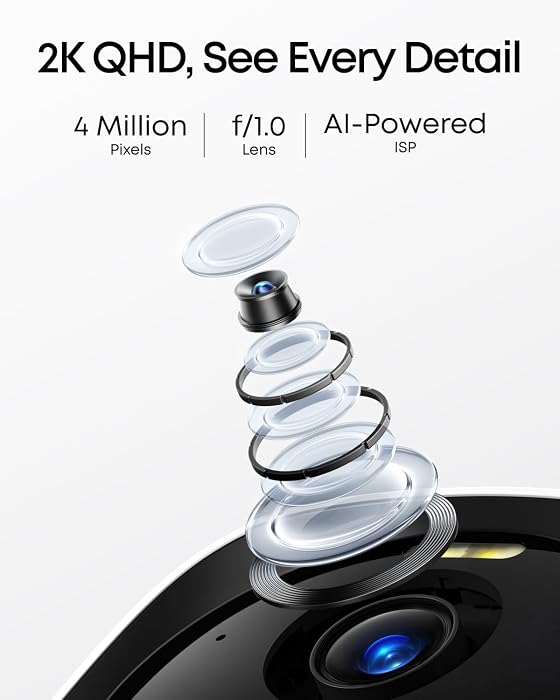
The visual foundation of the eufy e40 outdoor camera specs centers around its 2K QHD video capture resolution encoded in standard MPEG-4 format. Moving from standard 1080p to 2K resolution yields a substantially denser pixel count across the camera’s field of view. This pixel density provides clear digital enlargement capabilities, allowing property owners to resolve critical identifying details such as facial features, package labels, or clothing textures at property boundaries and driveways.
Where the camera diverges significantly from standard outdoor optical assemblies is its inclusion of an F/1.0 aperture lens. In optical design, an F/1.0 aperture represents an exceptionally wide physical opening relative to its focal length, permitting a massive volume of ambient light photons to strike the image sensor. Standard security lenses typically operate between F/1.6 and F/2.0, which severely chokes available light when dusk falls and forces the camera to switch over to infrared monochrome modes or trigger blinding LED floodlights.
By leveraging this F/1.0 aperture through eufycam e40 maxcolor night vision technology, the unit produces vivid, full-color surveillance footage even in near-total darkness. Users gain realistic color rendition of clothing, vehicle finishes, and hair color without flooding the yard with intrusive high-lumen spotlights. For yards requiring continuous perimeter lighting, high-output fixtures such as the eufy floodlight cam e340 serve a different tactical purpose, but the E40 achieves clear evening identification through pure low-light lens efficiency.
Solar Panel Architecture and 13,000 mAh Endurance
Power management is the primary engineering hurdle for wire-free security hardware. The eufycam e40 solar battery life relies on a dual-layer power approach that pairs an integrated top-facing solar panel with an internal 13,000 mAh lithium-based reserve battery. A cell capacity of 13,000 mAh is roughly double to triple the reserve found in typical battery-powered cameras, establishing a massive energy buffer before any solar replenishment is even factored in.
The solar panel integrated into the chassis features a flat, non-peeling composite design built directly into the top casing. Traditional peel-and-stick or laminated solar layers on consumer electronics often suffer from environmental degradation, delamination, and clouding caused by ultraviolet exposure and heavy rainfall. By using a hardened, non-peeling solar interface, the panel maintains its photovoltaic conversion efficiency over extended outdoor deployments. The unit also includes a flexible USB backup charging port, giving users an alternative input method if the camera is deployed in a shaded breezeway or interior alcove.
This power subsystem allows the camera to operate continuously for months without manual recharging cycles, maintaining active monitoring even through extended stretches of overcast or rainy weather. Coupled with an IP66 weather-resistance certification, the internal battery chemistry and electrical contacts remain fully insulated against driven rain, blowing dust, sleet, and seasonal temperature swings, making it structurally sound for year-round perimeter security.

PIR Sensing and On-Device Detection Logic
A high-resolution optical sensor is ineffective if the camera records empty wind-blown tree branches or drains its battery on passing shadows. The eufyCam E40 mitigates false alerts by utilizing a two-tier hardware and software detection pipeline. First, an upgraded Passive Infrared (PIR) sensor monitors for real-world changes in thermal signatures across its monitoring zone. Because PIR sensors only react to radiating heat sources moving through the field, non-thermal motion like falling leaves, wind gusts, or minor lighting shifts never wake the main processing unit.
Once the PIR sensor confirms thermal movement, the camera wakes its internal processor to execute edge-based artificial intelligence classification algorithms. This software layer evaluates the detected form against trained models to categorize whether the entity is a human, a household pet, or a motorized vehicle. Property owners receive instant push notifications to their smartphones that accurately label the event, eliminating the alert fatigue associated with basic motion-sensing cameras.
Because all initial AI classification occurs on-device, processing latency is reduced to fractions of a second, ensuring users get immediate alerts as soon as an intrusion event begins. Furthermore, storing footage locally through your central base station rather than relaying video to remote cloud servers safeguards personal privacy and eliminates recurring storage subscriptions. Those who appreciate local data containment across high-tier security hardware, such as the eufy c37 4k, will find this local processing pipeline aligns with private surveillance principles.

Hub Dependency and Ecosystem Compatibility
The most important consideration before buying is understanding the eufy e40 add on camera requirements. The eufyCam E40 is strictly an add-on unit; it does not contain a direct-to-router standalone Wi-Fi radio and cannot operate as an independent surveillance camera. To function, it must communicate with either a HomeBase S380 (also known as HomeBase 3) or a HomeBase 2. Shoppers who do not already own a compatible HomeBase unit must factor that hub into their system architecture.
Understanding eufy e40 homebase compatibility clarifies why this dedicated hub architecture is beneficial for outdoor properties. Offloading local storage, deep cryptographic encryption, and long-range sub-gigahertz wireless transmission to an indoor base station preserves the camera’s internal 13,000 mAh battery reserves. The camera communicates directly with the HomeBase, which houses your local storage drives, manages network security, and synchronizes system-wide automations across multiple perimeter zones. When comparing different generations in this line, such as the eufy e42 outdoor camera, verified compatibility with HomeBase S380 ensures access to unified data management.
On the smart platform side, the eufyCam E40 integrates with Apple HomeKit, Amazon Alexa, and Google Assistant. Alexa and Google Assistant integrations enable two-way voice commands and video streaming to smart displays like Echo Show or Nest Hub devices. Apple HomeKit support gives iOS users native management through the Apple Home application. The physical eufy e40 outdoor camera setup takes approximately 10 minutes: the chassis secures to exterior masonry or wood siding with a two-screw bracket, pairs through the eufy Security smartphone app via a quick sync procedure, and begins surveillance immediately.
eufyCam E40 Pros and Cons
Pros
- Ultra-wide F/1.0 aperture for full-color night video
- Massive 13,000 mAh battery with integrated solar panel
- On-device AI detection for persons, pets, and vehicles
- Zero ongoing monthly cloud subscription fees
- Durable IP66 weatherproofing against extreme outdoor elements
- Multi-platform support for Apple HomeKit, Alexa, and Google
Cons
- Requires separate HomeBase hub to operate
- Integrated solar panel position cannot be adjusted independently
- Optimized for event recording rather than continuous 24/7 capture
Is the eufyCam E40 Worth It
Determining whether the eufyCam E40 fits your security strategy comes down to your current hardware ecosystem and your local environmental layout. For homeowners who already operate a eufy HomeBase S380 or HomeBase 2, this add-on camera delivers immense value. It combines high-end F/1.0 optics, dependable 2K resolution, and an enormous 13,000 mAh battery sustained by a rugged, non-peeling solar panel, providing true set-and-forget monitoring without any monthly cloud subscriptions.
The camera is particularly well suited for properties where running electrical conduit is impractical, such as distant fence lines, detached garages, or rear patio walls. The high-aperture MaxColor night vision provides a clear tactical advantage over cameras that rely on blinding spotlights, gathering crisp, full-color nighttime intelligence without broadcasting the camera’s location to everyone walking past your property line.
Conversely, this camera is not the right choice for individuals looking for a standalone plug-and-play Wi-Fi camera that operates without an indoor hub. If you do not own a HomeBase and do not intend to invest in one, the E40 cannot be initialized or operated. Similarly, users who demand 24/7 continuous video recording should look toward hardwired Power-over-Ethernet configurations, as the solar and battery architecture of the E40 is intentionally optimized for event-triggered clip surveillance.
FAQ
Can the eufyCam E40 work without a HomeBase?
No, the eufyCam E40 cannot function as an independent camera. The official technical specifications require connection to either a HomeBase S380 or a HomeBase 2. The hub is necessary to manage network routing, camera synchronization, and local video storage.
How does MaxColor night vision operate without visible spotlights?
MaxColor night vision relies on an ultra-wide F/1.0 optical aperture lens paired with a high-sensitivity sensor. The lens physically gathers enough ambient light from distant street lamps, moonlight, and porch lights to render a clear, full-color image in near-total darkness without turning on high-intensity LED floodlights or dropping to monochrome infrared.
What happens if the solar panel is covered by snow or experiences prolonged cloud cover?
The camera houses an expansive 13,000 mAh internal rechargeable battery designed to provide months of operational reserve even through extended periods of overcast weather. If the panel is obscured by heavy snow or installed in heavy shade, you can clear the flat panel or use the integrated USB backup charging port to replenish the internal cell manually.
Does the eufyCam E40 require a monthly subscription fee?
No monthly subscription or cloud payment is required. All captured video recordings, AI detection processing, and playback functionality operate locally through your connected HomeBase unit, ensuring complete data ownership with zero recurring maintenance fees.
Which smart home systems can control the eufyCam E40?
The eufyCam E40 provides out-of-the-box support for Apple HomeKit, Amazon Alexa, and Google Assistant. You can use voice commands through compatible smart speakers and view live feeds on compatible smart display hardware.
What does the physical installation process involve?
The physical installation process takes roughly 10 minutes and does not require electrical wiring. The package includes an outdoor wall bracket secured using two mounting screws. Once mechanically affixed to an exterior wall, fence post, or garage fascia, the camera syncs with your HomeBase via the eufy Security app on your smartphone.
See the current listing on Amazon
Specifications on this page are read from the product listing. Scores are out of 10, based on listed specifications and buyer feedback.


