As Amazon Associates, we earn from qualifying purchases. This means we may receive a small commission at no extra cost to you if you click through and make a purchase.

- Brand
- Dewalt
- Our score
- 9.2 out of 10
- Very positive
Commercial technicians and industrial fleet mechanics evaluating extreme-torque cordless tools face an uncompromising question: does a cordless impact gun possess the sustained mechanical leverage needed to replace pneumatic shop lines on heavy equipment? For demanding maintenance operations, the DeWalt DCF961 serves as the manufacturer’s flagship answer. Operating as a brushless dewalt 20v max high torque impact wrench, this bare-tool model is engineered specifically for operators who service commercial truck chassis, earthmoving machinery, structural steel assemblies, and high-pressure pipe flanges. The central buying consideration focuses on whether its exceptional breakaway power justifies the physical heft of its bare-tool configuration, designated under model number DCF961B.
A rigorous review of the published dewalt dcf961 specs reveals an engineering focus centered on extreme rotational yield and multi-stage electronic drive regulation. This guide examines the verified operational data behind the tool’s performance benchmarks, detailing the mechanical implications of the certified dewalt 961 breakaway torque rating, the four-stage speed architecture, and the automated power ramp mechanism. Throughout the following analysis, we benchmark performance advancements found in the dewalt dcf961 vs dcf899 platform shift, analyze real-world dewalt dcf961 battery compatibility, and evaluate whether this heavy-duty bare tool matches your workshop requirements.
What You Get With the DeWalt DCF961
When ordered under the DCF961B model identifier, the impact wrench ships as a bare tool intended for integration into an active 20V battery ecosystem. The official listing outlines the following integrated hardware features and core components:
- High-efficiency brushless motor delivering 1320 ft-lbs of maximum fastening torque and 1900 ft-lbs of breakaway torque
- Heavy-duty 1/2-inch socket anvil featuring a hog ring friction retainer for rapid socket changeovers
- Four-stage operational mode selector including 3 primary speed settings and a dedicated Precision Wrench control setting
- Automated electronic power boost that delivers increased power after 4 continuous seconds of impacting
- Adjustable integrated LED work light providing targeted illumination directly across the working axis
- Durable alloy steel housing assembly with a brushed finish designed for harsh jobsite environments
- Single-tool bare package (DCF961B); compatible 20V battery packs and charging stations are sold separately
Key Specifications
| Specification Attribute | Manufacturer Specification |
|---|---|
| Model Designation | DCF961B (Bare Tool Only) |
| Motor Design | Cordless Brushless |
| Nominal System Voltage | 20 Volts (20V MAX / XR Platform) |
| Drive Anvil Dimensions | 1/2-Inch Hog Ring Socket End |
| Maximum Fastening Torque | 1320 ft-lbs |
| Maximum Breakaway Torque | 1900 ft-lbs |
| Operational Speed Modes | 3 Speed Settings plus Precision Wrench Mode |
| Automated Output Modulation | Power increase triggered automatically after 4 seconds of impacting |
| Overall Tool Length | 8.43 inches |
| Bare Tool Weight | 8.4 pounds |
| Structural Material | Alloy Steel Construction with Brushed Finish |

Torque Performance and Breakaway Power
In heavy mechanical trades, raw rotational leverage governs jobsite productivity. The DCF961 generates 1320 ft-lbs of maximum fastening torque and 1900 ft-lbs of maximum breakaway torque, establishing class-leading output within the cordless 1/2-inch segment. This exceptional dewalt 1/2 inch impact wrench torque provides technicians with the capacity needed to unseat seized wheel studs, frozen track bolts, and high-tensile structural fittings without reverting to breaker bars. Utilizing the dewalt dcf961 for heavy equipment servicing eliminates the operational restrictions of pneumatic air lines, allowing mechanics to conduct high-load repairs directly in field yards or highway service shoulders.
The magnitude of this power upgrade becomes clear when examining the generational shift in the dewalt dcf961 vs dcf899 comparison. Manufacturer testing benchmarks indicate that the DCF961 produces up to 71% more torque than the preceding DCF899 platform, representing a substantial leap in motor winding density and mechanical hammer mass. Where the legacy platform would occasionally stall against heat-cycled, rust-welded commercial hardware, the revised drivetrain maintains sustained impact force. Technicians who already rely on heavy industrial equipment, such as a specialized dewalt 20v rotary hammer drill for concrete anchoring, will appreciate having comparable heavy-duty output available in a handheld fastener platform.
A notable electronic feature outlined in the manufacturer documentation is the automated 4-second impact boost mechanism. When the anvil encounters severe resistance that resists initial impacts, the tool’s onboard control unit monitors continuous hammer activity. After 4 seconds of uninterrupted impacting, the motor automatically commands an increase in rotational output power to assist in loosening stubborn fasteners. This dynamic power delivery conserves battery charge during standard fastening cycles while ensuring full mechanical force is automatically applied when breaking loose seized industrial bolts.

Precision Wrench Mode and Electronic Speed Control
Uncontrolled torque in a high-output impact wrench introduces severe mechanical risks, including stripped threads, sheared fasteners, and distorted mounting flanges. To prevent these failures, the unit features a comprehensive 4-mode drive selection interface that includes 3 standard speed settings alongside an integrated dewalt dcf961 precision wrench mode. By adjusting the speed profile, operators can dial down rotational speed and impact frequency for lighter fasteners, ensuring that the 1320 ft-lb maximum fastening ceiling is engaged only when seating heavy-duty structural steel bolts or large-diameter industrial pipe flanges.
The operational logic behind Precision Wrench mode provides dual-stage electronic oversight for both forward and reverse rotations. In forward mode, the system runs at normal operating speed until the hammer begins impacting, at which point it pauses briefly to prevent overtorquing and allow the operator to achieve final torque specifications with a manual torque wrench. In reverse mode, the tool applies full breakaway force to unseat the fastener, but instantly decelerates rotational speed once the fastener breaks free from the thread interface. This control algorithm effectively eliminates fastener run-off, preventing heavy nuts from spinning loose and dropping into vehicle chassis or deep gravel.
Visual verification is equally critical when seating high-torque sockets inside recessed mechanical housings. The DCF961 addresses dark work environments by integrating an on-tool LED work light with selectable brightness settings. Located strategically above the battery mount, the light beam projects upward across the socket perimeter, illuminating rusted fasteners inside wheel wells, equipment undercarriages, and poorly lit mechanical bays without casting obtrusive shadows across the anvil.
Form Factor, Weight, and Physical Handling
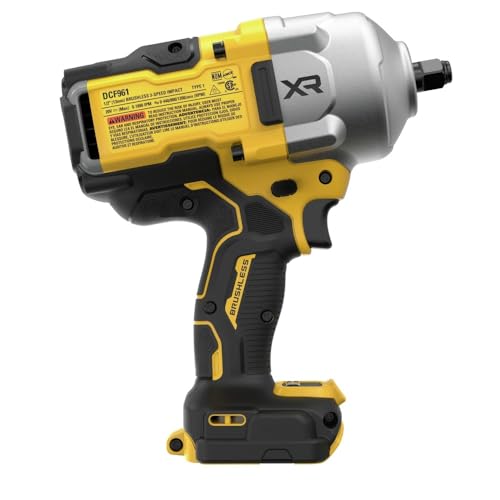
A detailed inspection of the dewalt dcf961b bare tool specs demonstrates the direct engineering trade-off between massive mechanical output and tool portability. Weighing 8.4 pounds in bare-tool form and measuring 8.43 inches in total length, this unit possesses substantial physical bulk. Built with a solid alloy steel front nosecone and brushed exterior surfaces, the tool is structurally reinforced to survive repeated industrial shock loads. However, the 8.4-pound bare weight requires deliberate operator stamina, especially during overhead structural bolting or prolonged fleet wheel rotations where two-handed control becomes mandatory.
Anvil architecture directly dictates shop workflow efficiency, and the DCF961 utilizes a 1/2-inch socket end fitted with a hog ring friction retainer. While detent-pin anvils are engineered for semi-permanent socket retention in high-elevation bridge construction, the hog ring design is optimized for service shops requiring continuous socket swaps across various metric and SAE sizes. Sockets snap firmly over the spring-steel friction ring with hand pressure and can be removed without secondary release pins, minimizing downtime during complex mechanical teardowns.
Because this heavy impact wrench utilizes an industrial 1/2-inch square drive anvil, its internal mass and torsional output are calibrated strictly for heavy impact-rated sockets. Operators performing complementary drilling, sheet-metal assembly, or light screwdriving tasks routinely preserve this tool for structural fasteners while delegating general fastener tasks to accessory systems like the dewalt dwa2ngft40ir impact ready flextorq setup. The alloy steel construction ensures long-term gear durability under intense cyclic impact shock without risking premature casing fracture.

Battery Compatibility and Cordless Ecosystem Integration
Sustaining 1900 ft-lbs of breakaway torque requires a continuous high-current power supply from the tool’s electrical interface. Regarding system versatility, dewalt dcf961 battery compatibility encompasses the complete line of 20V MAX and 20V XR slide-style lithium-ion batteries. However, pairing a high-drain brushless impact motor with standard low-capacity slim packs compromises performance by inducing voltage drop under high mechanical resistance. To fully leverage the tool’s automated 4-second power boost and reach maximum breakaway ratings, operators should pair the tool with high-capacity premium battery packs featuring low internal cell resistance.
For shops already invested in the manufacturer’s cordless platform, integrating the DCF961B bare tool expands heavy-duty mechanical capability without duplicating chargers or power packs. Technicians operating multi-tool workshop fleets—such as a diversified dewalt max xr tool setup—can hot-swap existing high-output batteries directly into this flagship wrench. Because the retail listing specifies the bare tool package without batteries or chargers included, buyers should assess their current charging infrastructure to ensure high-amperage batteries are readily available for demanding maintenance cycles.
DeWalt DCF961 Pros and Cons
Pros
- 1900 ft-lbs maximum breakaway torque
- 1320 ft-lbs maximum fastening torque
- Up to 71% more torque than DCF899
- Precision Wrench mode helps prevent overtightening
- Automated power boost after 4 seconds of impacting
- Fast socket changes with 1/2-inch hog ring anvil
Cons
- Heavy bare tool weight at 8.4 pounds
- Battery and charger sold separately
- Bulky 8.43-inch overall tool length
Is the DeWalt DCF961 Worth It
Evaluating whether is dewalt dcf961 worth it comes down to the scale of fasteners you encounter and whether pneumatic lines currently restrict your workflow. For diesel mechanics, mobile heavy equipment technicians, structural ironworkers, and industrial pipe maintenance crews, this tool represents an exceptional upgrade. Delivering a massive 1900 ft-lbs of breakaway torque alongside 1320 ft-lbs of fastening capacity, it eliminates frozen hardware that would otherwise stall standard mid-torque impacts, substantially accelerating teardown schedules and eliminating the need for stationary air compressors.
Conversely, for DIY hobbyists, residential auto maintenance, or general light-construction contractors, the DCF961 is impractical and ergonomically excessive. At 8.4 pounds before attaching a heavy-duty battery pack, using this tool for routine automotive maintenance or light suspension components introduces unnecessary operator fatigue and elevated risks of overtorquing smaller hardware. General automotive maintenance rarely requires torque exceeding standard shop thresholds, making lighter mid-torque tools far more comfortable for everyday passenger car servicing.
For professional commercial shops that maintain an existing 20V MAX battery inventory, the DCF961B bare tool provides exceptional mechanical utility. It packs commercial-grade breakaway power into an 8.43-inch chassis, supported by the protective Precision Wrench drive mode and the automated 4-second torque surge feature. When your daily workload regularly involves stubborn truck wheel lugs, seized agricultural machinery fittings, and large-sized pipe-flanges, this high-torque impact wrench offers the uncompromising mechanical capability required to complete the job.
FAQ
What is the maximum breakaway torque rating of the DeWalt DCF961?
The DeWalt DCF961 produces a certified maximum breakaway torque of 1900 ft-lbs and a maximum fastening torque of 1320 ft-lbs, making it the highest rated max torque cordless 1/2-inch impact wrench according to the listing data.
How much more torque does the DCF961 provide compared to the DCF899?
According to official manufacturer data, the DCF961 delivers up to 71% more torque than the legacy DCF899 model, providing substantially increased mechanical headroom for breaking loose seized fasteners.
What is the function of the Precision Wrench mode?
Precision Wrench mode helps prevent overtightening in forward mode by regulating impact force and reduces rotational speed in reverse once the fastener breaks loose to prevent fastener run-off.
Does the DCF961B model include a battery and charger?
The listing does not include a battery or charger with the DCF961B; it is sold as a bare tool only, requiring separate compatible 20V MAX batteries and charging equipment.
What type of anvil retention system does the DCF961 feature?
The tool is equipped with a 1/2-inch square drive anvil featuring a hog ring friction retainer designed for quick, manual socket changes without the use of release pins.
How does the automated 4-second power boost operate?
After 4 continuous seconds of impacting against severe fastener resistance, the tool’s electronic controls automatically increase motor output power to assist in loosening stubborn or corroded hardware.
See the current listing on Amazon
Specifications on this page are read from the product listing. Scores are out of 10, based on listed specifications and buyer feedback.