As Amazon Associates, we earn from qualifying purchases. This means we may receive a small commission at no extra cost to you if you click through and make a purchase.

- Brand
- Bambulab
- Buyer rating
- 4.2 out of 5
- Mostly positive, average of Amazon buyer ratings
When selecting a high-speed desktop additive manufacturing workstation, technical professionals must evaluate how feed drive mechanics, chamber thermals, and material management intersect under continuous operation. The Bambu Lab P2S Combo represents an integrated motion and multi-material feed ecosystem built to execute complex toolpaths at velocities reaching 600 mm/s. Inquiries regarding technical benchmarks and bambu lab h2 specs center on whether this system can sustain dimensionally stable output across dense production schedules without succumbing to extrusion variance or thermal creep. This bundle pairs an enclosed core machine with an external multi-filament processing system that integrates active heating to stabilize moisture-sensitive engineering polymers.
Determining if this workstation aligns with your engineering workflow requires understanding the boundary between the standalone motion platform and the complete combo hardware setup. While the core printer handles dynamic toolhead repositioning, the inclusion of the secondary unit resolves the mechanical challenge of material swapping and conditioning before polymer strands enter the melt zone. The comprehensive bambu lab p2s specs illustrate an automated approach designed to eliminate manual leveling, nozzle maintenance friction, and feed rate discrepancies. The following analysis examines extruder mechanics, chamber thermoregulation, multi-spool feed reliability, and software ecosystem demands to help you determine if this hardware fits your production standards.
What You Get With the Bambu Lab P2S Combo
The bundle integrates the core automated motion chassis with a dedicated multi-spool handling and filament conditioning enclosure. Rather than forcing users to purchase aftermarket dry boxes or third-party splitters, the system supplies direct inter-module connectivity for automated feed transitions right out of the box, though secondary spare items like auxiliary build surfaces or external scraping tools are not itemized on the listing.
- Bambu Lab P2S 3D printer enclosed chassis finished in grey
- AMS 2 Pro multi-material management unit supporting automated spool cycling
- PMSM Servo Extruder drive assembly featuring integrated Active Flowrate Compensation
- Adaptive Airflow System with active thermal balancing and built-in carbon filtration
- Toolhead carriage fitted with a Bambu Lab quick-swap nozzle mechanism
- In-chamber filament drying module in the AMS 2 Pro capable of sustained temperatures up to 65 °C
- Automated sensor array driving AI failure detection and automated bed leveling calibration
- MakerWorld integration coupled with Bambu Studio and Bambu Handy software control workflows
Key Specifications
| Attribute | Specification Detail |
|---|---|
| Maximum Print Speed | Up to 600 mm/s |
| Extruder Drive Architecture | PMSM Servo Extruder with Active Flowrate Compensation |
| Multi-Material System | AMS 2 Pro (Multi-Color and Multi-Material Automation) |
| Filament Conditioning | Built-in AMS drying up to 65 °C |
| Thermal Chamber Regulation | Adaptive Airflow System maintaining up to 50 °C chamber |
| Air Filtration | Integrated activated carbon filter |
| Toolhead Interface | Quick-swap nozzle system |
| Machine Dimensions | 18″D x 22″W x 18″H |
| Item Total Weight | 46.3 pounds |
| Model Number & Manufacturer | PF004-U+SA007-AU / Shenzhen Tuozhu Technology Co., Ltd |

PMSM Servo Extruder Dynamics and Deposition Precision
High-speed material deposition introduces complex non-linear pressures within the melt zone that standard open-loop stepper motors struggle to regulate. The drive mechanism of the core machine employs a permanent-magnet synchronous motor, elevating pmsm servo extruder performance well beyond conventional desktop feed drives. Because a PMSM servo delivers continuous torque feedback and maintains closed-loop positional tracking, the drive gears avoid missed steps during violent accelerations. When pushing linear toolhead speeds up to 600 mm/s, instantaneous velocity changes at sharp corners demand microsecond adjustments in filament tension to prevent corner bulges or starved infill tracks.
Active Flowrate Compensation operates in tandem with the servo motor to counteract the natural viscoelastic lag of molten thermoplastics. As the print carriage decelerates into a 90-degree corner, chamber backpressure tends to force an excess bead of material past the orifice unless back-off retraction is executed with precision. By calculating the real-time pressure gradient inside the hotend, the controller instructs the drive mechanism to regulate volumetric output continuously. Detailed technical evaluations of the bambu labs p2s highlight how this closed-loop servo feedback eliminates the seams and ringing artifacts that frequently compromise high-velocity structural prototypes.
Maintenance overhead is mitigated through the inclusion of the Bambu Lab quick-swap nozzle assembly. Traditional threaded hotends require high-temperature thermal tightening to avoid catastrophic polymer leakage between the heatbreak and nozzle interface. The quick-swap mechanical coupling allows operators to exchange worn orifices or switch between different flow configurations rapidly without bringing the hotend to extreme operating temperatures first. While the listing does not specify the exact factory nozzle diameter or metal alloy composition, the quick-change framework reduces assembly downtime during scheduled maintenance intervals.

Chamber Thermal Regulation for Technical Filaments
Depositing structural polymers requires rigid environmental temperature management to prevent inter-layer shear failure and base warping. Operating the Bambu Lab P2S for engineering materials relies entirely on the internal enclosure dynamics governed by the adaptive airflow system bambu engineered into the chassis. High-performance filaments like polycarbonates and specialized copolyesters require elevated ambient heat to arrest volumetric shrinkage as extruded beads crystallize, whereas standard polylactic acid requires aggressive cross-flow draft to solidify fine overhangs before sag occurs.
The integrated environmental controller balances these conflicting requirements by regulating air intake, internal circulation, and exhaust flow automatically. To suppress warping across broad structural footprints, the enclosure actively retains thermal energy to maintain a Bambu Lab P2S chamber temperature of up to 50 °C. By stabilizing ambient internal thermals at this threshold, internal stress concentrations within the cooling part are minimized, preventing perimeter lifting from the build surface. When switching back to low-temperature filaments, the airflow vents automatically adjust to dump excess ambient heat, keeping cooling ducts charged with cold air to preserve sharp overhang definitions.
Sustained elevated chamber temperatures present air quality challenges when technical filaments outgas volatile organic compounds and sub-micron particulates during plasticization. The internal circulation pathway incorporates an integrated activated carbon filter designed to capture airborne emissions directly from the internal draft. This filtration stage ensures that technical materials can be processed in shared office environments and laboratory spaces without venting noxious fumes into the immediate operator zone, maintaining a clean work envelope around the machine.

AMS 2 Pro Integration and In-Chamber Spool Conditioning
Automated multi-spool handling introduces mechanical complexity that often causes feed binding if filament path friction or moisture levels are unmanaged. The combo package resolves this by pairing the chassis with the secondary feeding module to enable ams 2 pro multi-color printing across four distinct spool pathways. The primary standalone machine cannot execute multi-color transitions independently; acquiring the combo hardware configuration is required to achieve automated multi-material indexing. When executing dual-material prints with soluble or breakaway support structures, the secondary unit indexes, retracts, and feeds contrasting spools to the primary toolhead without manual operator intervention.
Filament degradation caused by ambient moisture absorption is a primary source of structural delamination, foaming, and nozzle clogging in engineering thermoplastics. The ams 2 pro addresses this failure mode by integrating active in-chamber filament drying that reaches sustained temperatures up to 65 °C. Rather than relying on passive desiccant packs that saturate quickly in humid facilities, the active thermal element drives bound moisture out of the spools while they sit staged for printing. This thermal conditioning ensures that materials like nylon blends or sensitive polyesters remain dried throughout long print jobs spanning multiple days.
Operational reliability during multi-spool transitions depends on tight mechanical tolerances throughout the feed tubing and internal retraction buffers. The active drive gears in the secondary unit monitor spool rotation, preventing tangled coils and detecting feed resistance before a brittle strand can snap inside the lower guide path. Operators evaluating extended material setups can also examine the bambu lab ams ht documentation to compare alternative multi-material configurations across the wider hardware catalog, ensuring their selected feeding setup meets specific spool volume requirements.
Calibration Automation and Workspace Deployment
Transitioning from unboxing to initial part production is designed to take approximately 15 minutes due to factory pre-assembly and integrated routine automation. Traditional Cartesian and CoreXY platforms typically demand manual squaring, belt tension measuring, and analog dial-indicator tramming before laying down a baseline calibration cube. The P2S ecosystem bypasses these setup hurdles by executing automated sensor-driven bed compensation and dynamic resonance sweeps directly upon initial power-up, establishing precise positional offsets without user guesswork.
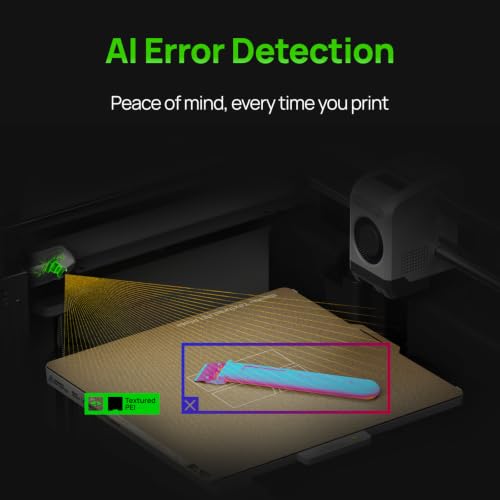
During live print operations, an optical and sensor-driven AI failure detection array oversees the deposition plane. If layer shifting, Spaghetti failure, or bed detachment occurs, the monitoring routine halts carriage motion to protect the toolhead assembly from engulfment in molten plastic. This failsafe monitoring is reinforced by Bambu Lab P2S compatibility across local and networked interfaces. Users supervise telemetry, send sliced G-code, and control print queues via Bambu Studio on Windows 10 workstations or remotely through the Bambu Handy application on mobile smartphones, linking directly with the MakerWorld model repository for verified print profiles.
Physical planning for the workstation requires accounting for both module footprints and combined system mass. The overall product dimensions measure 18 inches deep, 22 inches wide, and 18 inches high, with a combined system weight of 46.3 pounds. The substantial weight provides structural inertia that helps damp vibrations generated by the 600 mm/s print velocities, but it necessitates a rigid, level workbench to avoid resonance transfer. Readers assessing physical bench footprints and mounting options in our bambu lab p2s combo 3d printer review will note that sufficient overhead and rear clearance must be preserved to access the multi-material feed lines cleanly.
Bambu Lab P2S Combo Pros and Cons
Pros
- PMSM servo extruder with closed-loop flowrate compensation
- High velocity printing up to 600 mm/s
- AMS 2 Pro drying chamber heating to 65 °C
- Adaptive airflow system maintaining 50 °C chamber
- Rapid 15-minute setup with automated calibration
- Quick-swap nozzle mechanism for rapid maintenance
Cons
- Standalone P2S lacks multi-color support without combo
- Substantial total package weight of 46.3 pounds
- Operating system support explicitly itemized for Windows 10
Is the Bambu Lab P2S Combo Worth It
Determining whether this hardware system justifies integration comes down to throughput demands, material complexity, and tolerance for manual machine calibration. For engineering teams, prototyping labs, and industrial designers who frequently switch between rigid structural materials and flexible support matrices, the combo bundle offers significant efficiency advantages. The pairing of a 50 °C thermal chamber with an active 65 °C filament drying feeder directly resolves the two biggest bottlenecks in processing technical filaments: moisture pickup and part warping. When calculated across dozens of production hours, the elimination of manual bed tramming, failed moisture-laden prints, and thermal re-runs provides substantial operational value.
Conversely, for casual hobbyists focused strictly on simple, single-color decorative prints using standard PLA, the full capabilities of the combo package may exceed basic workshop requirements. The base standalone machine does not support multi-color printing on its own, making the combo essential only if multi-material automation is mandatory. Furthermore, buyers working on lightweight shelving or compact desks may find the 46.3-pound assembly and substantial 22-inch width cumbersome to integrate into cramped environments. If your workflow never demands composite filaments, active spool drying, or rapid 600 mm/s print execution, a simpler bed-slinger machine may suffice.
Ultimately, is bambu lab p2s worth it for technical users seeking industrial-style consistency on a desktop? The answer is affirmative for users who prioritize automated process controls, closed-loop PMSM servo extrusion, and reliable multi-spool transitions. By taking operational variables like flowrate lag, chamber cooling, and filament moisture out of the equation, the P2S Combo delivers a repeatable manufacturing cell that operates with minimal supervisory overhead.
FAQ
Does the base Bambu Lab P2S support multi-color printing without the combo?
No, the standalone P2S 3D printer does not support multi-color or multi-material printing on its own. The AMS 2 Pro module included with the Combo version is strictly required to handle automated filament retraction, color cycling, and secondary material feeding into the toolhead.
What is the maximum chamber temperature achievable on the Bambu Lab P2S?
The internal Adaptive Airflow System is designed to regulate environmental temperatures and maintain an internal chamber temperature of up to 50 °C. This thermal retention minimizes thermal shock and warping when producing parts with engineering-grade materials.
How does the AMS 2 Pro handle hygroscopic engineering filaments?
The AMS 2 Pro features a built-in active filament drying system capable of heating internal spools up to 65 °C. This active heating continuously evaporates absorbed environmental moisture from the filament while stored inside the unit, ensuring dry material delivery to the melt zone.
How quickly can the Bambu Lab P2S Combo be assembled and deployed?
The listing outlines a ready-to-print setup time of approximately 15 minutes. The rapid deployment is enabled by automated leveling routines, self-calibrating resonance compensation, pre-assembled chassis framing, and quick-swap nozzle mechanisms that remove manual tramming steps.
Which computer operating systems and devices work with the Bambu Lab P2S ecosystem?
The machine interfaces with personal computers running Windows 10 utilizing the Bambu Studio slicing software. Remote job control, video monitoring, and print tracking are also supported on mobile smartphones via the Bambu Handy application, which integrates with the MakerWorld model repository.
See the current listing on Amazon
Specifications on this page are read from the product listing. Ratings are the average left by Amazon buyers.


