As Amazon Associates, we earn from qualifying purchases. This means we may receive a small commission at no extra cost to you if you click through and make a purchase.

- Brand
- Anker
- Our score
- 8.4 out of 10
- Mostly positive
Selecting a portable solar collector for mobile power stations requires looking past simple wattage stickers to evaluate real-world silicon efficiency, mechanical durability, and total field weight. If you are seeking an ultralight generation source for off-grid recreation, overland vehicle setups, or residential emergency storage, the Anker SOLIX PS100 is engineered to address the weight and thermal degradation penalties typical of legacy portable arrays. As a modern anker 100w portable solar panel built on N-type silicon rather than older P-type wafers, this unit targets rapid solar harvesting while remaining exceptionally easy to deploy, reorient, and pack away.
This technical anker solix ps100 review explores the engineering metrics that define the AS310 hardware platform. We dissect the official anker solix ps100 specs, assess the real-world utility of bifacial dual-sided energy absorption, calculate how the lightweight chassis impacts structural rigidity, and examine bundled connectivity including the proprietary DC interface cables. By examining both verified performance figures and notable hardware limitations, this analysis helps you determine whether this compact bifacial solar collector matches your field power architecture.
What You Get With the Anker SOLIX PS100
The Anker SOLIX PS100 ships with the primary collector assembly along with dedicated extension and adapter cabling required for immediate connection to modern portable battery banks:
- Anker SOLIX PS100 bifacial portable solar panel (Model AS310) with integrated kickstand support.
- Two 8.2-foot (2.5-meter) solar extension charging cables designed for extended placement flexibility.
- One 1.6-foot (0.5-meter) XT60i solar charging cable for direct attachment to high-current power station input receptacles.
- Quick start documentation detailing panel angle adjustment, series wiring precautions, and basic care.
- Safety guide and warranty documentation certifying official manufacturer support.
Key Specifications
| Technical Parameter | Manufacturer Specification |
|---|---|
| Rated Output Capacity | 100 Watts |
| Solar Cell Architecture | Next-generation N-type monocrystalline |
| Base Conversion Efficiency | 25%+ cell efficiency |
| Bifacial Generation Potential | Up to 10% supplemental power via rear capture |
| Operational Chassis Weight | 7 lb (including integrated kickstand) |
| Product Dimensions | 23.62 inches L x 0.67 inches W x 40.55 inches H |
| Enclosure Protection Rating | IP68 water and dust ingress resistance |
| Frame Construction Materials | Reinforced aluminium frame and composite backing |
| Design Service Life | 10-year operational expectancy |
| Warranty Coverage Duration | 5 years (60 months) |

N-Type Solar Cell Architecture and Thermal Efficiency Under Load
The core distinguishing technical metric of the PS100 is its reliance on advanced N-type silicon wafers. In conventional consumer solar arrays, standard P-type PERC cells have long served as the baseline standard. However, P-type boron-doped silicon is inherently vulnerable to light-induced degradation and suffers from steeper power curve falloffs when surface temperatures rise under direct summer exposure. By contrast, anker solix ps100 n-type cells utilize phosphorus doping, creating an electron-rich semiconductor matrix that resists initial light degradation while delivering a certified baseline conversion efficiency of over 25 percent.
In standard outdoor environments, solar modules routinely operate well above laboratory test benchmarks. Surface temperatures on dark solar laminate frequently reach between 120 and 145 degrees Fahrenheit on clear afternoons. Standard panels drop output considerably under such conditions due to adverse thermal voltage coefficients. The N-type wafer architecture in this anker solix solar panel limits this energy dissipation, allowing the panel to hold higher operating voltages throughout mid-day thermal peaks.
Beyond baseline thermal stability, the high initial efficiency rating translates to a more compact surface footprint for a 100-watt output class. Delivering 100 watts from a smaller active surface area minimizes total chassis weight while generating adequate power to sustain critical camp devices or maintain small-capacity power stations without requiring bulky multi-panel linkages.

Dual-Sided Output Dynamics and Bifacial Ground Reflection
The secondary optical feature of the hardware is its bifacial energy capture mechanism, engineered to harness reflected ambient light from the ground surface behind the panel. Dual-sided solar modules incorporate a transparent or semi-transparent backsheet beneath active semiconductor cells, allowing indirect, diffuse photons to strike the rear junction layer. According to manufacturer engineering data, this bifacial design can yield up to an additional 10 percent supplemental power over front-face generation alone under favorable surface conditions.
Achieving meaningful rear-panel production depends heavily on the surface albedo of the surrounding terrain. When the panel is deployed over surfaces with elevated albedo ratings—such as light-colored concrete, dry sand, crushed limestone, or snowpack—a substantial fraction of incident light bounces upward against the underside of the panel. On dark turf, dense forest soil, or wet asphalt, ground reflectance drops significantly, reducing rear-face output toward zero. Readers evaluating anker solix ps100 bifacial efficiency must recognize that the secondary 10 percent power boost is environmentally conditional rather than an automatic constant.
Deployment angle also plays a critical mechanical role in rear-side generation. Laying the panel completely flat against a vehicle rooftop, roof rack, or insulated ground mat completely blocks ambient photons from accessing the rear junction layer, functioning essentially as a standard monofacial panel. To fully activate bifacial collection, the panel must be deployed on its built-in kickstand, angled between 30 and 45 degrees relative to the ground plane, providing an unobstructed optical path beneath the lower edge of the frame.

Cabling Architecture and Power Station Compatibility
Electrical interconnects and line loss considerations dictate practical charging speed in field scenarios. Anker bundles a dedicated wiring kit consisting of two 8.2-foot (2.5-meter) extension leads paired with a 1.6-foot (0.5-meter) anker solix ps100 xt60i cable adapter. The combined lead length gives users nearly 10 feet of spatial separation between the solar collector and the charging battery, which is essential for keeping sensitive lithium batteries shaded beneath vehicle awnings or foliage while leaving the solar panel fully exposed to direct sunlight.
Interoperability centers around the integrated XT60i connector standard, which includes an internal sense pin recognized by intelligent charge controllers. When linked to compatible stations such as the anker solix 800 power unit, the XT60i connection guarantees proper current limiting, preventing erratic charging cycles or thermal throttling. The standardized solar connectors also allow straightforward adaptation to third-party power generators that utilize DC5521, Anderson Powerpole, or standard XT60 inputs, provided polarity and voltage limits are maintained.
Evaluating anker solix ps100 compatibility requires noting one specific specification gap: the listing does not specify exact open-circuit voltage (Voc) or maximum power voltage (Vmp) figures. Standard 100W portable panels generally present an operating voltage between 18V and 22V, making them universally compatible with 12V to 24V MPPT charge controllers found in systems like the anker solix c1000. However, users planning high-voltage series arrays should consult documentation before chaining more than two panels together.
Field Portability and Structural Weatherproofing
Mechanical portability often involves difficult trade-offs between frame rigidity and travel weight. At an official anker ps100 solar panel weight of just 7 pounds including its built-in structural stand, the unit is roughly 10 percent lighter than its direct predecessor and over 30 percent lighter than typical legacy 100-watt framed panels. This reduced mass makes the panel exceptionally practical to transport by hand from storage compartments to camp perimeters without causing carrying fatigue.
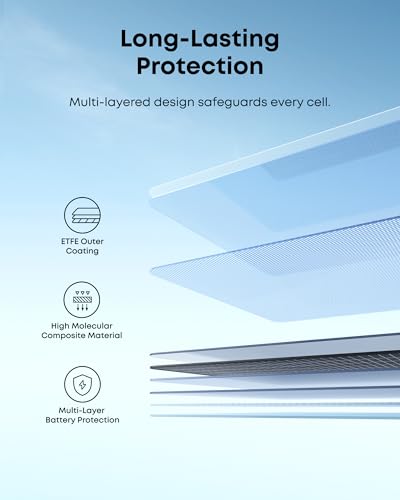
Despite this low overall weight, structural integrity is reinforced through an aluminium perimeter subframe coupled with impact-resistant composite backing. The product dimensions measure 23.62 inches long by 0.67 inches wide by 40.55 inches high when fully deployed. While the listing does not specify separate folded dimensions, the ultra-slim 0.67-inch profile ensures the panel slides easily into camper van storage slots, vehicle trunks, or closet recesses between trips.
Weather resistance represents another standout engineering metric. The panel carries an official IP68 rating, designating complete ingress protection against airborne dust and continuous immersion in water under specified conditions. For users deploying the anker solix ps100 for camping, remote hunting, or multi-day overland tours, sudden rainstorms, mud splashes, or shoreline sand will not damage the internal electrical contacts or fog the front encapsulation laminate. It pairs naturally with mobile cooling hardware like the anker solix everfrost 2, providing continuous daytime replenishment under unpredictable outdoor conditions.
Anker SOLIX PS100 Pros and Cons
Pros
- High 25%+ conversion efficiency from N-type cells
- Ultralight 7-pound chassis with built-in kickstand
- Rugged IP68 waterproof and dustproof protection
- Bifacial generation adds up to 10% supplemental power
- Generous 5-year manufacturer warranty coverage
Cons
- Listing does not specify folded transport dimensions
- Listing omits operating voltage and current ratings
- Rear bifacial boost requires high-albedo ground surfaces
Is the Anker SOLIX PS100 Worth It
Determining whether the Anker SOLIX PS100 matches your specific gear profile depends heavily on your daily power consumption and mobile storage constraints. For solo campers, van lifers, tailgaters, and field researchers who require a manageable 100-watt replenishment stream, this collector delivers an exceptional blend of low carrying weight, high-efficiency silicon, and class-leading weather protection. The 7-pound chassis combined with IP68 construction makes it far more forgiving in real-world mud and rain than competing consumer panels encased in soft canvas wraps.
However, if your primary objective is recharging massive multi-kilowatt-hour home backup reserves during prolonged electrical grid outages, an individual 100W panel will present throughput bottlenecks. Recharging a large storage pack from zero to full using a single 100W array requires multiple days of ideal solar exposure. Buyers with high continuous loads should consider either multiple panels deployed in parallel or higher-wattage commercial arrays, accepting the corresponding increases in weight and packing bulk.
When evaluated strictly within the 100-watt portable category, the engineering integration of N-type cells, bifacial potential, comprehensive cabling, and reinforced framing positions this panel as an elite off-grid companion. If lightweight transport, superior thermal performance in hot climates, and certified water resistance align with your packing priorities, this panel represents an exceptionally well-engineered investment for your mobile power kit.
FAQ
How much does the solar panel weigh including the integrated kickstand?
The total weight of the solar panel, including its built-in kickstand assembly, is 7 pounds. This makes it roughly 10 percent lighter than the prior generation and more than 30 percent lighter than conventional 100-watt portable solar panels on the market.
What specific charging cables come inside the box?
The panel includes two 8.2-foot (2.5-meter) solar extension charging cables and one 1.6-foot (0.5-meter) XT60i solar charging cable, alongside the standard quick start guide and safety card.
What is the conversion efficiency rating of the N-type solar cells?
The panel features next-generation N-type monocrystalline solar cells with a certified conversion efficiency rating of over 25 percent, designed to minimize energy loss and maintain higher operating performance in elevated ambient temperatures.
How does the bifacial generation feature produce extra electricity?
The dual-sided architecture allows the back surface of the panel to capture ambient and ground-reflected sunlight. When angled above reflective surfaces like snow, sand, or concrete, this rear capture can generate up to an additional 10 percent supplemental power beyond front-side production.
Is the panel fully waterproof against heavy outdoor rain?
Yes, the panel carries an official IP68 ingress protection rating, certifying full protection against dust ingress and high-level water resistance, allowing it to withstand severe rainstorms, mud, and outdoor exposure during camping deployments.
See the current listing on Amazon
Specifications on this page are read from the product listing. Scores are out of 10, based on listed specifications and buyer feedback.